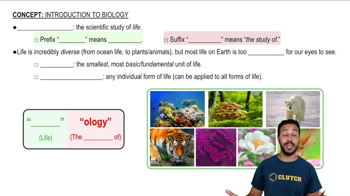
What are the six common characteristics that define life?
Acquire and use materials and energy, actively maintain organized complexity, sense and respond to stimuli, grow, reproduce, and evolve collectively.
What is the basic unit of life?
The cell, which is separated from its surroundings by a membrane and contains various structures and chemicals in a fluid environment.
What distinguishes unicellular from multicellular organisms?
Unicellular organisms consist of a single cell, while multicellular organisms consist of two or more cells.
How do organisms acquire energy?
Organisms obtain energy through photosynthesis (autotrophic) or consumption (heterotrophic). All life energy comes directly or indirectly from the sun.
What does it mean that organisms maintain organized complexity?
Living things use energy to maintain internal order and homeostasis, such as regulating body temperature and chemical balance.
What is homeostasis?
The maintenance of relatively constant internal conditions like body temperature, blood pH, and water levels.
How do organisms sense and respond to stimuli?
Organisms detect external and internal stimuli through sensory organs or receptors and respond accordingly.
How do plants, fungi, and bacteria respond to stimuli?
They respond to environmental changes such as light, chemicals, and temperature, similar to animals.
How do organisms grow?
Growth involves increasing size by producing more cells (plants and animals) or enlarging cells before division (bacteria).
How do organisms reproduce?
Organisms reproduce by cell division, producing seeds, live young, or eggs, passing DNA to offspring.
What is evolution in biological terms?
Evolution is the change in DNA within a population over generations, leading to modifications in organisms.
What is a population in biology?
A group of the same type of organism living in the same area.
What is the role of DNA in living organisms?
DNA carries genetic information passed from parents to offspring, guiding growth, reproduction, and function.
Why is energy essential for life?
Energy is required to maintain organization, perform chemical reactions, grow, and reproduce.
What is the difference between autotrophic and heterotrophic organisms?
Autotrophs make their own food via photosynthesis; heterotrophs consume others for energy.
What happens if energy is not used to maintain organization in living things?
Organization tends to disintegrate, leading to loss of life functions.
What is the significance of the cell membrane?
It separates the cell from its environment and controls the movement of substances in and out.
How do cells maintain chemical reactions necessary for life?
By pumping chemicals in and out to create suitable internal conditions.
What is the relationship between photosynthesis and energy flow in ecosystems?
Photosynthesis traps solar energy, which is then transferred through food chains sustaining ecosystems.
How does the scientific method relate to biology?
It is a systematic approach to inquiry used to investigate biological questions and problems.
 Indietro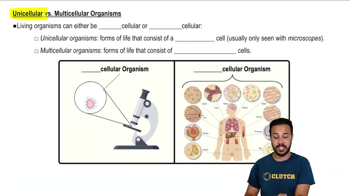
 02:09
02:09