 Indietro
General Biology: Introduction to Metabolism
 02:17

Termini in questo insieme (24)
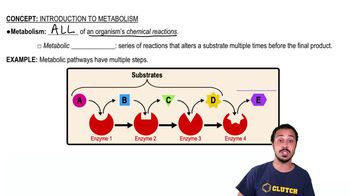
Metabolism is the totality of an organism's chemical reactions, arising from orderly molecular interactions.
Metabolic pathways begin with a specific molecule and end with a product, with each step catalyzed by a specific enzyme.
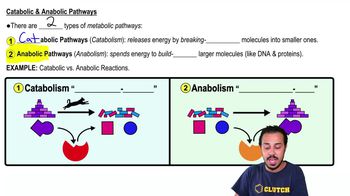
Catabolic pathways release energy by breaking down complex molecules; anabolic pathways consume energy to build complex molecules.
Bioenergetics is the study of how energy flows through living organisms.
Kinetic energy is energy of motion; thermal energy is kinetic energy from random movement of atoms or molecules.
Potential energy is energy due to location or structure; chemical energy is potential energy available for release in chemical reactions.
Energy can be transferred and transformed but cannot be created or destroyed; total energy of the universe is constant.
Every energy transfer or transformation increases the entropy (disorder) of the universe.
Entropy is a measure of molecular disorder or energy dispersal in a system.
Organisms create ordered structures but increase the total entropy of the universe by releasing heat and less ordered forms of matter.
Free energy is the portion of a system's energy that can perform work at uniform temperature and pressure.
A negative \(\Delta G\) means the reaction is spontaneous and can perform work.
At equilibrium, forward and reverse reactions occur at the same rate; the system is at maximum stability and no net work is done.
Cells are open systems with constant material flow, preventing equilibrium and allowing metabolism to proceed.
Exergonic reactions release energy and are spontaneous (negative ΔG); endergonic reactions absorb energy and are nonspontaneous (positive ΔG).
ATP hydrolysis releases energy used to drive endergonic reactions by transferring a phosphate group (phosphorylation).
ATP consists of ribose sugar, adenine base, and three phosphate groups linked in a chain.
ATP is hydrolyzed to ADP and inorganic phosphate, releasing energy due to the chemical change to a lower free energy state.
Enzymes are specific to substrates due to the shape of their active site, forming an enzyme-substrate complex.
Enzymes lower activation energy by orienting substrates, straining bonds, and providing a favorable microenvironment.
Temperature, pH, substrate concentration, and cofactors influence enzyme activity; each enzyme has optimal conditions.
Cofactors are nonprotein helpers; coenzymes are organic cofactors, often derived from vitamins.
Allosteric regulation occurs when a molecule binds to a site other than the active site, altering enzyme activity.
Feedback inhibition is when the end product of a metabolic pathway inhibits an earlier enzyme to prevent overproduction.