 Indietro
General Biology Key Concepts
 02:09
02:09

Termini in questo insieme (37)
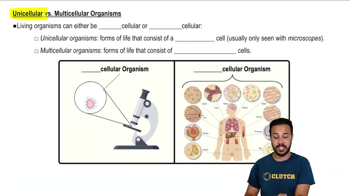
Living things are made of cells, use energy (metabolism), maintain homeostasis, grow and develop, reproduce, respond to the environment, and evolve over time.
All living organisms are made of cells; the cell is the basic unit of life; all cells come from preexisting cells.
Individuals vary; some traits help survival and reproduction; beneficial traits become more common over generations in populations.
An inherited trait that improves survival or reproduction in a specific environment, like polar bear fur or cactus water storage.
Genes are located on chromosomes, which carry genetic information passed from parents to offspring.
Flow of genetic information: DNA is transcribed into RNA, which is translated into protein.
Mutations are changes in DNA sequence that create genetic variation, essential for evolution.
Shows evolutionary relationships, common ancestors, and relatedness among species.
For energy to power metabolism and cellular work, and raw materials to build and repair cells.
Atom: smallest unit of matter; Element: substance of one atom type; Isotope: atoms of same element with different neutrons.
Protons (positive, in nucleus), Neutrons (neutral, in nucleus), Electrons (negative, orbit nucleus).
Atomic number = number of protons; Mass number = protons + neutrons.
The outermost electron shell; valence electrons determine chemical bonding.
Covalent (shares electrons), Ionic (transfers electrons), Hydrogen (weak attraction between polar molecules).
Polar, cohesion, adhesion, high specific heat, excellent solvent, expands when frozen; important for temperature regulation and chemical reactions.
Acids release H⁺ (pH < 7), bases accept H⁺ or release OH⁻ (pH > 7), buffers resist pH changes to maintain stability.
Carbon-containing molecules essential for life: carbohydrates, lipids, proteins, nucleic acids.
Carbon has four valence electrons and can form four covalent bonds, allowing diverse complex molecules.
Compounds with the same molecular formula but different structures, leading to different functions.
Monomers are small building blocks; polymers are many monomers linked together, e.g., amino acids form proteins.
Dehydration synthesis removes water to build polymers; hydrolysis adds water to break polymers apart.
Contains an amino group (NH₂), carboxyl group (COOH), hydrogen, R-group (side chain), and central carbon.
Bond between two amino acids linking them into protein chains.
Primary: amino acid sequence; Secondary: alpha helices and beta sheets; Tertiary: 3D shape; Quaternary: multiple polypeptide chains.
Act as enzymes, transport molecules, provide structure, allow movement, send signals, and defend against disease.
Loss of protein shape caused by heat, pH changes, chemicals, or salt changes, resulting in loss of function.
Composed of a phosphate group, five-carbon sugar, and nitrogenous base.
DNA: double-stranded, deoxyribose sugar, thymine, stores genetic info; RNA: single-stranded, ribose sugar, uracil, involved in protein synthesis.
Made of C, H, O; provide quick energy, energy storage, and structural support (e.g., glucose, starch, cellulose).
Fats store energy; phospholipids form membranes; steroids act as hormones and stabilize membranes.
Hydrophilic heads face water; hydrophobic tails face inward, forming a bilayer that is the membrane's main structure.
Membrane is a flexible phospholipid bilayer with embedded moving proteins allowing transport and communication.
Movement of molecules from high to low concentration without energy.
Diffusion of water across a selectively permeable membrane.
Hypertonic: water leaves, cell shrinks; Hypotonic: water enters, cell swells; Isotonic: no net water movement.
Movement of substances against concentration gradient (low to high) using ATP and transport proteins.
Endocytosis: cell takes in materials via vesicles; Exocytosis: cell releases materials via vesicles.