 Indietro
General Biology Key Concepts
 09:26
09:26
Termini in questo insieme (30)
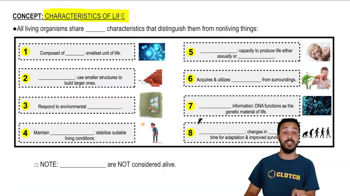
1. organization and order 2. transmission of info in the form of dna 3. transformation of energy and matter 4. interactions at different levels 5. evolution
Molecule, organelle, cell, tissue, organ, organism, population, community, ecosystem, biosphere
Prokaryotic: No nucleus, no membrane-bound organelles
Eukaryotic: Has nucleus and membrane-bound organelles
DNA is transcribed into mRNA, which is then translated into amino acids to form proteins.
1. Photosynthesis/ solar energy 2. consume producers or other consumers 3. absorbs nutrients from nonliving materials
Order of ranks from domain to species
Domain, kingdom, phylum, class, order, family, genus, species
Domains: Bacteria, Archaea, Eukarya
Eukarya includes: Protists, plants, fungi, animals
Evolution: Change in heritable traits of populations over generations
Natural selection: Differential survival and reproduction of individuals due to trait differences
Qualitative: Descriptive data
Quantitative: Numerical data
A species extensively studied to understand biological processes applicable to other organisms.
Matter: Anything with mass and volume
Element: Pure substance of one type of atom
Compound: Substance of two or more elements chemically combined
Atom: Smallest unit of an element
Carbon (C), Hydrogen (H), Oxygen (O), Nitrogen (N)
Protons: Positive, nucleus
Neutrons: Neutral, nucleus
Electrons: Negative, electron cloud
Atomic number: Number of protons
Mass number: Protons + neutrons
Atoms of the same element with different numbers of neutrons.
Valence shell: Outer electron shell
Orbital: Region where electrons are likely found
Nonpolar covalent, polar covalent, ionic, hydrogen, van der Waals interactions
The tendency of an atom to attract electrons in a chemical bond.
Water has polar covalent bonds between H and O; hydrogen bonds form between molecules.
Cohesion, high specific heat, water expands when it freezes, solvent abilities
Thermal energy: Total kinetic energy of particles
Temperature: Average kinetic energy
Hydrophobic: Water-fearing, nonpolar
Hydrophilic: Water-loving, polar or charged
Acid: Donates (increases) H+ ions Base: Accepts (lowers) H+ ions
Body fluids usually 6-8; blood pH is tightly regulated around 7.35-7.45
It lowers pH, harming marine life and disrupting ecosystems.
Carbon has 4 valence electrons and forms 4 covalent bonds with various atoms.
They vary in length, branching, double bond position, and ring formation.
Compounds of only carbon and hydrogen; important as energy sources and structural components.
Structural isomers and geometric (cis-trans) isomers
Hydroxyl group: -OH
Carboxyl group: -COOH