 Indietro
General Biology Key Concepts
 09:26
09:26
Termini in questo insieme (30)
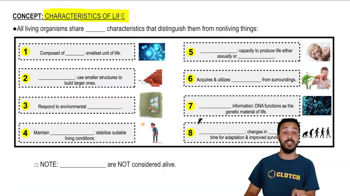
Complex organized structure, acquire material and energy, maintain structure and regulate internal environment, respond to stimuli, growth, reproduction, and ability to evolve.
From smallest to largest: Subatomic particles → Atoms → Molecules → Organelles → Cells → Tissues → Organs → Organ systems → Multicellular organisms → Populations → Community → Ecosystem → Biosphere.
The tendency of life to maintain structure and regulate the internal environment, e.g., sweating to cool the body.
Asexual: one parent, offspring genetically identical. Sexual: two parents, offspring with combined genetic material.
Survival and reproduction of the fittest members of a population, leading to evolution by passing genes to future generations.
Atomic number: number of protons. Atomic weight: protons + neutrons.
Atoms of the same element with different numbers of neutrons, resulting in different atomic weights.
Ionic: attraction between oppositely charged ions after electron transfer. Covalent: atoms share electrons.
Polar: unequal sharing of electrons, resulting in partial charges. Nonpolar: equal sharing of electrons.
Weak attractions between polar molecules where a hydrogen atom covalently bonded to one atom is attracted to another atom.
Water is polar, has high cohesion and surface tension, high specific heat, high heat of vaporization, and expands when frozen.
Hydrophilic: substances that dissolve in water (polar/ionic). Hydrophobic: substances that do not dissolve in water (nonpolar).
Measures acidity from 0 to 14; pH < 7 acidic, pH = 7 neutral, pH > 7 basic; logarithmic scale where 1 unit change = 10× change in H+ concentration.
Seven main groups: Hydroxyl (-OH), Carbonyl (C=O), Carboxyl (-COOH), Amino (-NH2), Sulfhydryl (-SH), Phosphate (-PO4), Methyl (-CH3).
Dehydration synthesis: joins monomers by removing water. Hydrolysis: breaks polymers by adding water.
Monosaccharides are simple sugars (e.g., glucose). Disaccharides are two monosaccharides joined (e.g., sucrose). Polysaccharides are long chains (e.g., starch, glycogen, cellulose).
Primary: amino acid sequence; Secondary: helices and sheets stabilized by H bonds; Tertiary: 3D folding from side chain interactions; Quaternary: multiple polypeptide subunits.
Unfolding of protein structure due to disruption of weak interactions, potentially losing function.
Polymers of nucleotides, each with a sugar, phosphate group, and nitrogenous base; DNA has deoxyribose and is double-stranded; RNA has ribose and is single-stranded.
Mostly nonpolar, hydrophobic molecules including fats, oils, waxes, phospholipids, and steroids; important for energy storage and membranes.
Saturated: no double bonds, solid at room temperature. Unsaturated: one or more double bonds, liquid at room temperature.
Glycerol + 2 fatty acids (hydrophobic tails) + phosphate group (hydrophilic head); form bilayers in water.
Isolates cell contents, regulates material flow, and allows communication with other cells.
Prokaryotes lack nucleus and membrane-bound organelles; DNA in nucleoid. Eukaryotes have nucleus, organelles, and compartmentalization.
Double membrane organelle producing ATP; contains DNA and ribosomes; inner membrane folds called cristae.
Site of photosynthesis; double membrane; contains chlorophyll, DNA, ribosomes; thylakoids and grana inside.
Rough ER: has ribosomes, synthesizes proteins. Smooth ER: no ribosomes, synthesizes lipids.
Modifies, sorts, packages, and ships proteins and lipids; has cis (receiving) and trans (shipping) faces.
Digestive organelles for intracellular digestion, recycling cellular material, and programmed cell death.
Ribosome → Rough ER → Vesicle → Golgi apparatus → Vesicle → Plasma membrane → Outside cell.