 Indietro
General Biology Key Concepts
 01:35
01:35
Termini in questo insieme (27)
Biology is the scientific study of life and living organisms.
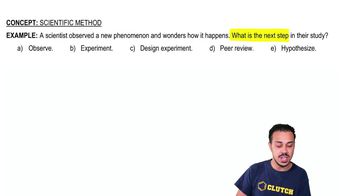
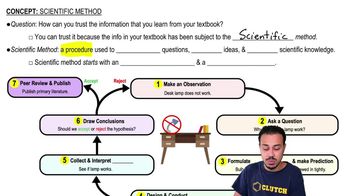
A hypothesis is a testable explanation for a scientific question or observation.
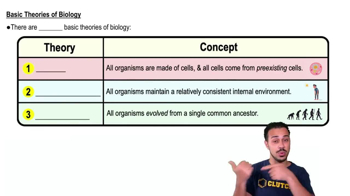
A theory is a well-supported explanation of natural phenomena based on a body of evidence.
A controlled experiment tests the effect of one variable by keeping all other variables constant.
The independent variable is the factor that is deliberately changed in an experiment.
The dependent variable is the factor that is measured or observed in response to changes in the independent variable.
Natural selection is the process where organisms better adapted to their environment tend to survive and produce more offspring.
Artificial selection is the human-directed breeding of organisms to produce desired traits.
Population ecology studies populations, their sizes, densities, and how they change over time.
Population density is the number of individuals of a species per unit area or volume.
A survivorship curve shows the proportion of individuals surviving at each age for a species.
The exponential growth model describes population growth without limits, increasing rapidly over time.
The logistic growth model describes population growth that slows as it approaches the carrying capacity.
Carrying capacity is the maximum population size an environment can sustain indefinitely.
Density-dependent factors affect population size based on population density, like competition and disease.
Density-independent factors affect population size regardless of density, such as natural disasters.
Biodiversity is the variety of life at genetic, species, and ecosystem levels.
A community is all the populations of different species living and interacting in an area.
An ecological niche is the role and position a species has in its environment.
Mutualism is an interspecific interaction where both species benefit (+/+).
Predation is an interaction where one species (predator) kills and eats another (prey) (+/-).
A food chain shows a linear sequence of who eats whom in an ecosystem.
A food web is a complex network of interconnected food chains in an ecosystem.
Primary succession is the gradual colonization of lifeless areas where no soil exists.
Secondary succession is the recovery of a disturbed ecosystem where soil remains.
Energy flows through ecosystems in one direction, from producers to consumers, and is lost as heat.
Biogeochemical cycles describe the movement of chemical elements between living and nonliving parts of ecosystems.