 Indietro
General Biology Key Concepts
 01:35
01:35
Termini in questo insieme (31)
Biology is the scientific study of life.
Organization, Information, Energy & Matter, Interaction, Evolution.
Atom → Molecule → Organelle → Cell → Tissue → Organ → Organ System → Organism → Population → Community → Ecosystem → Biosphere.
DNA stores, transmits, and uses information to determine cell function.
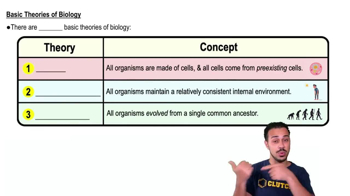
Evolution is the change in populations over generations, explaining unity and diversity of life.
Reductionism: study parts; Emergent Properties: whole is more than parts; Systems Biology: study interactions of parts.
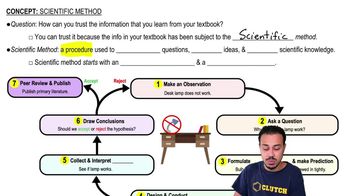
Observation → Question → Hypothesis → Prediction → Experiment → Data → Conclusion.
Hypothesis is a testable explanation; Theory is a broad explanation supported by evidence.
Inductive: specific observations to general conclusion; Deductive: general principle to specific prediction.
Smallest unit of an element retaining its properties, made of protons, neutrons, and electrons.
Atomic number = number of protons; Atomic mass ≈ protons + neutrons.
Atoms of the same element with different numbers of neutrons.
Electrons in the outermost shell that determine atom bonding behavior.
Ability of an atom to attract shared electrons; higher electronegativity means stronger attraction.
Covalent bonds share electrons; Ionic bonds transfer electrons creating ions.
Polar: electrons shared unequally due to different electronegativities; Nonpolar: electrons shared equally.
Weak attraction between a partially positive hydrogen and electronegative atom like oxygen or nitrogen.
Cohesion: water sticks to water; Adhesion: water sticks to other substances.
Water has a high specific heat, resisting rapid temperature changes and stabilizing environments.
pH 0-14: lower pH is acidic, higher is basic; buffers resist pH changes to maintain stability.
Carbohydrates, Lipids, Proteins, Nucleic Acids.
Monomer: small building block; Polymer: large molecule made of repeating monomers.
Dehydration builds polymers by removing water; Hydrolysis breaks polymers by adding water.
Energy, energy storage, and structural support.
Starch: plant energy storage; Glycogen: animal energy storage; Cellulose: plant structural support.
Saturated fats have no double bonds; unsaturated fats have one or more double bonds.
Phospholipids have hydrophilic heads and hydrophobic tails, forming cell membrane bilayers.
Primary: amino acid sequence; Secondary: local folds (α-helix, β-sheet); Tertiary: 3D shape; Quaternary: multiple chains.
Loss of protein shape and function caused by temperature, pH, or chemicals.
Prokaryotes: no nucleus, no membrane-bound organelles; Eukaryotes: nucleus and membrane-bound organelles.
Mitochondria and chloroplasts originated from bacteria engulfed by ancestral eukaryotic cells.