 Indietro
General Biology Key Concepts
 09:26
09:26
Termini in questo insieme (22)
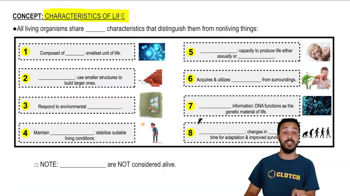
Life is characterized by organization, metabolism, homeostasis, growth, reproduction, response to stimuli, and evolution.
Evolution is the change in the genetic composition of populations over generations.
Includes observation, hypothesis, prediction, experiment, and conclusion.
A hypothesis is a testable explanation; a prediction is a specific outcome expected if the hypothesis is true.
The control group serves as a baseline to compare results and isolate the effect of the variable tested.
The independent variable is manipulated; the dependent variable is measured.
Molecule, organelle, cell, tissue, organ, organ system, organism, population, community, ecosystem, biosphere.
A molecule is two or more atoms bonded together, forming the chemical basis of life.
Organelles are specialized structures within cells that perform distinct functions.
The cell is the basic unit of life, capable of independent function and reproduction.
Tissues are groups of similar cells working together to perform a specific function.
An organ is a structure composed of multiple tissue types that perform a specific task.
An organ system is a group of organs that work together to perform complex functions.
An organism is an individual living entity capable of independent life.
A population is a group of organisms of the same species living in a specific area.
A community consists of all populations of different species living and interacting in an area.
An ecosystem includes all living organisms and their physical environment interacting as a system.
The biosphere is the global sum of all ecosystems, encompassing all life on Earth.
Prokaryotic cells lack a nucleus and membrane-bound organelles; eukaryotic cells have both.
Producers make their own food via photosynthesis; consumers obtain energy by eating other organisms.
Photosynthesis converts light energy into chemical energy, producing glucose and oxygen from carbon dioxide and water.
Energy flows from producers to consumers and decomposers, typically decreasing at each trophic level.