 Indietro
General Biology: Key Concepts and Foundations
 09:26
09:26
Termini in questo insieme (35)
Properties of a system as a whole
Reductionism isolates parts to understand their role; Systematic studies interactions between parts in biological systems.
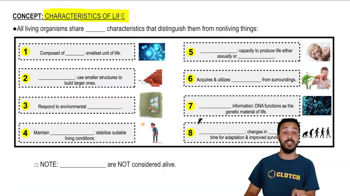
All living things are made of cells, which are the basic unit of life, enclosed by membranes and containing genetic material.
Eukaryotes have membrane-bound organelles and nucleus; Prokaryotes lack nucleus and have DNA in cytoplasm.
DNA is transcribed into RNA, which is translated into protein, describing gene expression.
Energy flows one way: sunlight → plants (producers) → consumers; matter can be recycled.
Interactions include mutualism, competition, parasitism, commensalism, and predation.
Traits are heritable; more offspring produced than survive; individuals with best traits survive and reproduce more, leading to evolution.
Observation → reasoning → hypothesis → experiments → troubleshooting → analysis → new hypotheses.
Inductive: specific observations to general hypothesis; Deductive: general system to specific prediction.
Independent variable is controlled by researcher; dependent variable changes in response.
About 20-25% of natural elements are essential; CHON (carbon, hydrogen, oxygen, nitrogen) make up 96% of living matter.
Isotopes differ in neutron number; radioactive isotopes decay releasing energy, used as tracers and for dating.
Electrons farther from nucleus have higher potential energy; energy changes when electrons move between shells.
Electrons in outermost shell (valence electrons) determine chemical reactivity; full valence shell means inertness.
Atoms share valence electrons to fill shells; can be single or double bonds, forming molecules.
Unequal sharing of electrons due to different electronegativities creates polar covalent bonds; equal sharing forms nonpolar bonds.
Formed when atoms transfer electrons, creating oppositely charged ions (cations and anions) that attract each other.
Weak bonds where a hydrogen covalently bonded to an electronegative atom is attracted to another electronegative atom.
Water molecules stick together via hydrogen bonds, creating high surface tension and enabling movement against gravity.
Water resists temperature change due to many hydrogen bonds, allowing it to absorb or release heat slowly.
Ice is less dense than liquid water because molecules form a crystal lattice, allowing ice to float.
Water's polarity allows it to dissolve ionic and polar molecules by surrounding ions with hydration shells.
Acids increase free H+ concentration; bases decrease it by accepting H+. pH scale measures acidity from 0 to 14.
Solutions that maintain stable pH by absorbing or releasing H+ or OH- ions, usually containing weak acids and bases.
Carbon has four unpaired valence electrons, allowing it to form four covalent bonds and diverse complex molecules.
Compounds with the same molecular formula but different structures: structural, cis-trans, and enantiomers.
Specific groups of atoms in organic molecules that determine chemical reactivity, e.g., hydroxyl, carboxyl, amino, phosphate.
Adenosine triphosphate stores and releases energy in cells by breaking phosphate bonds, acting as a cellular energy currency.
Four main classes: carbohydrates, lipids, proteins, and nucleic acids.
Polymers form by dehydration synthesis (removing water) and break down by hydrolysis (adding water).
Serve as fuel and structural material; monosaccharides form polysaccharides like starch (storage) and cellulose (structure).
Include fats (energy storage), phospholipids (membranes), and steroids (membrane fluidity); mostly hydrophobic.
Primary (sequence), secondary (alpha helices, beta sheets), tertiary (3D folding), quaternary (multiple polypeptides).
Loss of native structure due to environmental changes, reverting protein to primary structure and losing function.