 Indietro
General Biology: Key Concepts and Foundations
 09:26

Termini in questo insieme (27)
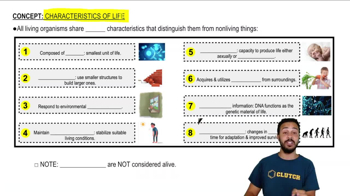
Growth, reproduction, response to stimuli, metabolism, homeostasis, cellular organization, and adaptation through evolution.
Observation, question, hypothesis, experiment, data collection, analysis, conclusion, and communication.
An experiment where only one variable is changed at a time while others are kept constant to test its effect.
Independent variable is the factor changed by the experimenter; dependent variable is the factor measured or observed.
A well-tested explanation that unifies a broad range of observations and hypotheses.
Larger sample sizes increase reliability and reduce the impact of random errors in data.
Data unlikely to have occurred by chance, indicating a real effect or relationship.
The disproven idea that living organisms can arise from nonliving matter spontaneously.
The theory that microorganisms are the cause of many diseases.
A scientist who disproved spontaneous generation and developed germ theory and pasteurization.
Used swan-neck flasks to show that sterilized broth remained free of microbes unless exposed to contaminated air.
A process of heating liquids to kill harmful microbes without affecting taste or quality.
Led Lister to use antiseptics to reduce infections during surgery.
The number of protons (and electrons in a neutral atom) in an atom.
Sum of protons and neutrons in the nucleus.
Atoms of the same element with different numbers of neutrons.
The outermost electron shell and the electrons in it that determine chemical bonding.
Covalent bonds (strongest), ionic bonds, and hydrogen bonds (weakest).
Occurs when a hydrogen atom covalently bonded to an electronegative atom is attracted to another electronegative atom.
A covalent bond where electrons are shared unequally, creating partial charges.
Water’s partial charges interact with other polar or charged molecules, allowing it to dissolve them.
Carbohydrates, lipids, proteins, and nucleic acids.
Monomers are small building blocks; polymers are large molecules made of monomers linked together.
Nucleotides composed of a sugar, phosphate group, and nitrogenous base.
Hydrogen bonds between complementary nitrogenous bases.
A central carbon bonded to an amino group, carboxyl group, hydrogen, and a variable side chain.
The linear sequence of amino acids in a polypeptide chain.