 Indietro
General Biology: Key Concepts and Learning Objectives
 09:26
09:26
Termini in questo insieme (27)
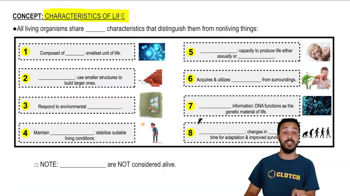
Living cells have properties such as organization, metabolism, growth, reproduction, response to stimuli, and homeostasis.
Includes observation, hypothesis development, experimentation, data analysis, and conclusion drawing.
A hypothesis is a testable prediction; a theory is a well-supported explanation based on many experiments.
The control group is not exposed to the variable; the experimental group is exposed to the variable being tested.
The independent variable is manipulated; the dependent variable is measured as the outcome.
Include evolution, flow of information, structure-function relationship, and interactions among organisms.
Atoms consist of protons, neutrons, and electrons; electrons form chemical bonds.
An atom is a single element unit; a molecule is two or more atoms bonded together.
Covalent bonds share electrons; ionic bonds transfer electrons between atoms.
Polar molecules have uneven charge distribution; non-polar molecules have even charge distribution.
Hydrophobic substances repel water; hydrophilic substances attract water.
Acidic solutions have pH < 7; basic solutions have pH > 7.
Hydrogen bonds stabilize structures like DNA and proteins and influence water properties.
Include carbohydrates, lipids, proteins, and nucleic acids.
Carbohydrates (monosaccharides), lipids (fatty acids), proteins (amino acids), nucleic acids (nucleotides).
From atoms to molecules, organelles, cells, tissues, organs, organisms, populations, communities, ecosystems, and biosphere.
Smaller cells have a higher surface area to volume ratio, facilitating efficient exchange of materials.
Include cell membrane, cytoplasm, ribosomes, and DNA.
Examples: mitochondria produce energy, chloroplasts conduct photosynthesis, nucleus stores DNA.
Includes nuclear envelope, ER, Golgi apparatus, lysosomes, and vesicles.
Explains evolution of mitochondria and chloroplasts as formerly free-living bacteria.
Composed of hydrophilic heads and hydrophobic tails forming a bilayer that controls substance movement.
Occurs mainly by osmosis through aquaporins in the cell membrane.
Active transport requires energy to move substances against gradient; passive transport does not.
Exocytosis exports materials out of the cell; endocytosis imports materials into the cell.
ATP transfers energy from exergonic to endergonic reactions by releasing phosphate groups.
Enzymes catalyze metabolic reactions by lowering activation energy and increasing reaction rates.