 Indietro
General Biology: Key Concepts and Themes
 09:26
09:26
Termini in questo insieme (25)
Biology is the scientific study of life and living organisms.
Order, regulation, evolutionary adaptation, reproduction, energy processing, response to the environment, growth, and development.
Emergent properties arise when components interact at a higher level, producing new functions not seen in individual parts.
Biosphere, ecosystems, communities, populations, organisms, organs, tissues, cells, organelles, molecules.
Reductionism is studying complex systems by breaking them down into simpler components.
Systems biology models interactions within biological systems across different organizational levels.
Organisms interact with living and nonliving factors, exchanging energy and chemicals in ecosystems.
Energy enters as sunlight, is converted to chemical energy by plants, flows through consumers, and exits as heat.
Structure and function are correlated; for example, leaf shape maximizes light capture for photosynthesis.
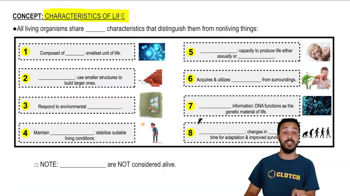
All living things are made of cells, which are the basic unit of structure and function, enclosed by membranes and containing DNA.
Prokaryotes lack a nucleus and membrane-bound organelles; eukaryotes have a nucleus and organelles.
DNA contains genetic information; genes are units of inheritance that guide protein production.
Gene expression converts DNA information into cellular products like proteins through transcription and translation.
Processes regulated by negative feedback (inhibition) or positive feedback (enhancement) to maintain homeostasis.
Evolution explains the unity and diversity of life through natural selection acting on inherited traits.
Bacteria, Archaea, and Eukarya, which include kingdoms like Plantae, Fungi, and Animalia.
A process involving observation, hypothesis formation, experimentation, data analysis, and conclusion.
Qualitative data are descriptive; quantitative data are numerical measurements.
Controls isolate the effect of one variable by comparing experimental and control groups.
A hypothesis is a testable prediction; an experiment tests the hypothesis by comparing groups.
Drawing general conclusions from many specific observations.
Using general premises to make specific predictions.
It must be testable and falsifiable through observation or experimentation.
A theory is broader, supported by extensive evidence, and can generate new hypotheses.
Science seeks to understand natural phenomena; technology applies scientific knowledge for practical purposes.