Skip to main content
General Biology
Il mio corso
Impara
Preparazione agli esami
AI Tutor
Guide di studio
Soluzioni per libri di testo
Flashcard
Esplora
Prova l'app
Il mio corso
Impara
Preparazione agli esami
AI Tutor
Guide di studio
Soluzioni per libri di testo
Flashcard
Esplora
Prova l'app
Indietro
General Biology: Key Concepts and Themes
Puoi toccare per girare la carta.
What are recurring themes in biology?
Puoi toccare per girare la carta.
👆
What are recurring themes in biology?
Recurring themes include the study of life at different levels, the flow of energy and cycling of matter, and the concept of emergent properties.
Avanzamenti del tracciato
I pulsanti di controllo sono stati cambiati in modalità "navigazione".
1/17
Video consigliati
02:09
Unicellular vs. Multicellular
37520
views
1378
rank
2
comments
02:54
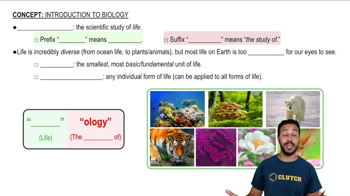
Introduction to Biology
59395
views
2193
rank
14
comments
1:28
Introduction to Biology Channel
70207
views
1777
rank
15
comments
Termini in questo insieme (17)
Nascondere definizioni
What are recurring themes in biology?
Recurring themes include the study of life at different levels, the flow of energy and cycling of matter, and the concept of emergent properties.
What levels can be studied in biology and how do they relate?
Biology studies levels from molecules to ecosystems, where each level builds on and interacts with the others.
Do matter and energy cycle or flow through an ecosystem?
Energy flows
through an ecosystem, while
matter cycles
within it.
What is systems biology?
Systems biology studies interactions within biological systems to understand how complex functions emerge.
What is reductionism in biology?
Reductionism breaks complex systems into simpler parts to study them individually.
List the five kingdoms of life in the five kingdom classification system.
The five kingdoms are
Monera
,
Protista
,
Fungi
,
Plantae
, and
Animalia
.
What are the three domains of life and which are prokaryotic or eukaryotic?
The three domains are
Bacteria
and
Archaea
(prokaryotic), and
Eukarya
(eukaryotic).
What is an emergent property?
An emergent property is a new function or characteristic that arises from the interaction of parts in a system.
What are the main characteristics shared by living things?
Living things share characteristics like growth, reproduction, response to stimuli, metabolism, and homeostasis.
What is the difference between a hypothesis and a theory?
A hypothesis is a testable prediction; a theory is a well-supported explanation based on evidence.
What is a controlled experiment?
A controlled experiment tests one variable at a time by comparing an experimental group to a control group.
What is the difference between dependent and independent variables?
The independent variable is manipulated; the dependent variable is measured as the outcome.
How do you interpret basic biological graphs?
Identify variables on axes, observe trends, and relate changes in the dependent variable to the independent variable.
What is the name of the book Charles Darwin published in 1859?
On the Origin of Species
.
How does natural selection work?
Natural selection favors individuals with traits that increase survival and reproduction in a given environment.
What is the peer review process?
Peer review evaluates scientific work by experts before publication to ensure quality and validity.
Why is peer review important to science?
It maintains scientific integrity by preventing flawed or biased research from being published.
 IndietroIndietro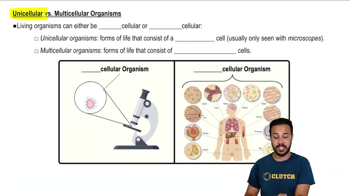
 02:09
02:09