Indietro

General Biology: Key Concepts and Themes

I pulsanti di controllo sono stati cambiati in modalità "navigazione".
1/24
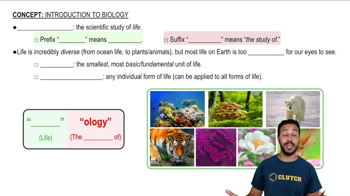
  • Five unifying themes of life

    • Organization/order
    • Expression and transmission of DNA information
    • Transfer and transformation of energy and matter
    • Interactions at small and large levels
    • Evolution
  • Biological hierarchy from largest to smallest

    1. Biosphere
    2. Ecosystems
    3. Communities
    4. Populations
    5. Organisms
    6. Organs
    7. Tissues
    8. Cells
    9. Organelles
    10. Molecules
    11. Atoms
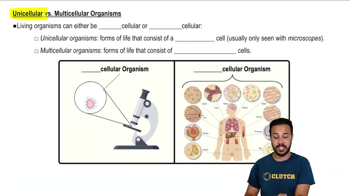
  • Difference between prokaryotic and eukaryotic cells

    • Prokaryotic: no nucleus, no membrane-bound organelles, small, less complex
    • Eukaryotic: have nucleus, membrane-bound organelles, large, complex
  • Structure and function relationship in biology

    At each biological level, structure correlates with function; analyzing structure helps understand function.
  • DNA structure and function

    DNA is a double helix made of nucleotides (nitrogenous base, phosphate group, sugar) that stores genetic information.
  • Gene expression process

    DNA is transcribed into mRNA, which is then translated into proteins.
  • Energy flow in ecosystems

    Energy flows one direction: enters as light, exits as heat; chemicals cycle within ecosystems.
  • Negative feedback regulation

    End product of a process slows down that process to maintain balance.
  • Definition of evolution

    Biological change where species accumulate inherited changes adapting to their environment.
  • Taxonomic classification order

    Domain, Kingdom, Phylum, Class, Order, Family, Genus, Species.
  • Three domains of life

    Domain Bacteria (prokaryotic), Domain Archaea (prokaryotic), Domain Eukarya (eukaryotic).
  • Charles Darwin's natural selection steps

    1. Population with varied traits
    2. Elimination of less fit individuals
    3. Reproduction of survivors
    4. Increased frequency of advantageous traits
  • Scientific method key components

    Observation, hypothesis (if/then format), experiment, control group, variables, data analysis.
  • Atom structure

    Atoms consist of protons (+), neutrons (no charge), and electrons (-) with a dense nucleus.
  • Isotopes

    Atoms of the same element with different numbers of neutrons.
  • Covalent bond

    Atoms share one or more pairs of electrons to form molecules.
  • Electronegativity

    An atom's attraction for electrons in a covalent bond; affects bond polarity.
  • Polar vs nonpolar covalent bonds

    Polar: unequal sharing of electrons; Nonpolar: equal sharing.
  • Hydrogen bond

    Weak bond where a slightly positive hydrogen atom is attracted to a partially negative atom in another molecule.
  • Properties of water that support life

    • Cohesion
    • Temperature moderation
    • Expansion upon freezing
    • Universal solvent
  • Acids and bases in water

    Acids increase H+ concentration (pH < 7); bases decrease H+ concentration (pH > 7).
  • Carbon's role in molecular diversity

    Carbon forms 4 bonds allowing diverse organic compounds essential for life.
  • Isomers

    Compounds with the same formula but different structures and properties.
  • Functional groups important for molecular function

    Hydroxyl, Carbonyl, Carboxyl, Amino, Sulfhydryl, Phosphate, Methyl.