 Indietro
General Biology Key Concepts
 01:35
01:35
Termini in questo insieme (30)
Quantitative data is numerical, while Qualitative data is descriptive observations.
Independent variable is what the researcher changes; Dependent variable is what is measured.
A control is the comparison or baseline condition in an experiment.
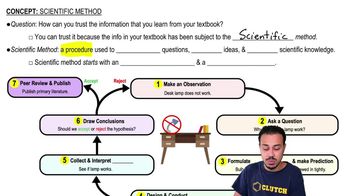
Hypothesis: testable explanation or prediction.
Theory: well-supported explanation.
Law: describes a consistent natural pattern.
Species names use Genus species format; Genus is capitalized, species lowercase, and both italicized (e.g., Homo sapiens).
Prokaryotic: no nucleus or membrane-bound organelles.
Eukaryotic: has nucleus and membrane-bound organelles.
Both have DNA, ribosomes, cell membrane, cytoplasm.
Fitness means reproductive success, not just strength or speed.
Atomic number = number of protons.
Mass number = protons + neutrons.
Neutrons = mass number − atomic number.
Proton: +1 charge
Neutron: 0 charge
Electron: −1 charge
Covalent: shares electrons.
Ionic: transfers electrons.
Hydrogen bond: weak attraction involving partial charges.
Valence electrons are in the outermost shell.
Electronegativity is how strongly an atom attracts shared electrons; greater difference means more polar bond.
Organic molecules are generally carbon-based.
Hydrocarbons contain only carbon and hydrogen, are nonpolar and hydrophobic.
Structural: different atom connectivity.
Cis-trans: different arrangement around double bonds.
Enantiomers: nonsuperimposable mirror images.
Element: one type of atom.
Compound: two or more different elements chemically bonded.
Matter: has mass and takes up space.
Solvent does the dissolving.
Solute gets dissolved.
Polar: uneven charge distribution.
Nonpolar: relatively even charge distribution.
Hydrophilic: interacts well with water.
Hydrophobic: does not interact well with water.
Hydroxyl (−OH): polar
Carbonyl (C=O): polar
Carboxyl (−COOH): acidic
Amino (−NH₂): basic
Sulfhydryl (−SH): forms disulfide bonds
Phosphate (−PO₄): often negative
Methyl (−CH₃): nonpolar
pH = −log[H⁺]
[H⁺] = 10⁻ᵖᴴ
More H⁺ → lower pH (acidic)
Less H⁺ → higher pH (basic)
Strong acids/bases completely dissociate in water.
Weak acids/bases partially dissociate.
A buffer resists pH changes, usually containing a weak acid and its conjugate base.
Cohesion: water sticks to water.
Adhesion: water sticks to other surfaces.
Surface tension: water surface resists breaking due to cohesion.
Water absorbs lots of heat with little temperature change (high specific heat).
It takes much energy to vaporize water (high heat of vaporization).
Ice is less dense than liquid water due to hydrogen bonding creating an open structure.
Carbohydrates, Lipids, Proteins, Nucleic Acids.
Monomer: monosaccharide (e.g., glucose). Functions: energy and structure (starch, glycogen, cellulose).
Includes fats, oils, phospholipids, steroids.
Triglyceride = glycerol + 3 fatty acids.
Saturated: no C=C bonds; unsaturated: one or more C=C bonds.
Phospholipids form cell membranes.
Primary: amino acid sequence.
Secondary: α-helices and β-sheets.
Tertiary: overall 3D shape.
Quaternary: multiple polypeptide chains.
Monomer: nucleotide (sugar + phosphate + nitrogenous base).
DNA base pairs: A-T, C-G.
Dehydration synthesis: removes water to build molecules.
Hydrolysis: adds water to break molecules apart.