Skip to main content
General Biology
Il mio corso
Impara
Preparazione agli esami
AI Tutor
Guide di studio
Soluzioni per libri di testo
Flashcard
Esplora
Prova l'app
Il mio corso
Impara
Preparazione agli esami
AI Tutor
Guide di studio
Soluzioni per libri di testo
Flashcard
Esplora
Prova l'app
Indietro
General Biology Key Concepts
Puoi toccare per girare la carta.
What are the main themes of biology?
Puoi toccare per girare la carta.
👆
What are the main themes of biology?
Organization, information, energy and matter, interaction, and evolution
are the main themes of biology.
Avanzamenti del tracciato
I pulsanti di controllo sono stati cambiati in modalità "navigazione".
1/29
Video consigliati
01:35
Scientific Method Example 1
13186
views
297
rank
03:03
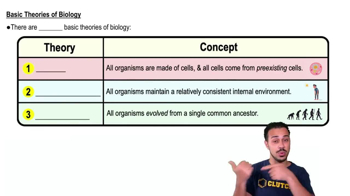
Basic Theories of Biology
13967
views
289
rank
1
comments
06:29
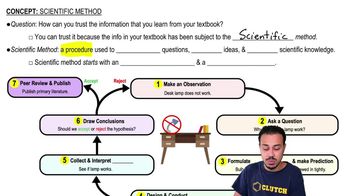
Scientific Method
22174
views
525
rank
1
comments
Termini in questo insieme (29)
Nascondere definizioni
What are the main themes of biology?
Organization, information, energy and matter, interaction, and evolution
are the main themes of biology.
Define reductionism in biology.
Reductionism
is the approach of studying complex systems by breaking them down into simpler components.
What are emergent properties?
Emergent properties
are new properties that arise at each level of biological organization that are not present at the simpler levels.
What is systems biology?
Systems biology
is the study of interactions among components of biological systems to understand how they function as a whole.
What is the scientific method?
The
scientific method
is a process involving observation, hypothesis formation, experimentation, and conclusion to test ideas.
Difference between inductive and deductive reasoning.
Inductive reasoning
derives generalizations from specific observations;
deductive reasoning
uses general principles to predict specific results.
Define hypothesis and theory in biology.
A
hypothesis
is a testable explanation; a
theory
is a well-supported, broad explanation of natural phenomena.
What is an atom?
An
atom
is the smallest unit of matter that retains the properties of an element.
What subatomic particles make up an atom?
Electrons
,
protons
, and
neutrons
are the subatomic particles of an atom.
Define atomic number and atomic mass.
Atomic number
is the number of protons;
atomic mass
is the total number of protons and neutrons in the nucleus.
What is an isotope?
An
isotope
is an atom of the same element with different numbers of neutrons.
Difference between molecule and compound.
A
molecule
consists of two or more atoms bonded together; a
compound
is a molecule with at least two different elements.
What are valence electrons?
Valence electrons
are the electrons in the outermost shell of an atom that participate in chemical bonding.
Describe covalent bonds.
Covalent bonds
involve sharing of electron pairs between atoms; can be single, double, triple, polar, or non-polar.
What is electronegativity?
Electronegativity
is the tendency of an atom to attract electrons in a chemical bond.
Define ion, cation, and anion.
An
ion
is an atom with a charge;
cation
is positively charged;
anion
is negatively charged.
What is an ionic bond?
An
ionic bond
is formed by the attraction between oppositely charged ions.
Difference between intramolecular and intermolecular bonds.
Intramolecular bonds
hold atoms together within a molecule;
intermolecular bonds
occur between molecules.
What is a hydrogen bond?
A
hydrogen bond
is a weak attraction between a hydrogen atom and an electronegative atom.
Define chemical reaction, reactants, and products.
A
chemical reaction
rearranges atoms;
reactants
are starting substances;
products
are substances formed.
What is chemical equilibrium?
Chemical equilibrium
occurs when the forward and reverse reaction rates are equal, stabilizing concentrations.
Explain cohesion and adhesion in water.
Cohesion
is water molecules sticking to each other;
adhesion
is water molecules sticking to other surfaces.
Define kinetic energy and temperature.
Kinetic energy
is energy of motion;
temperature
measures the average kinetic energy of molecules.
What is specific heat?
Specific heat
is the amount of heat needed to raise the temperature of 1 gram of a substance by 1°C.
Define solvent, solute, and aqueous solution.
A
solvent
dissolves substances; a
solute
is dissolved; an
aqueous solution
has water as the solvent.
What is pH scale?
The
pH scale
measures acidity or basicity of a solution from 0 (acidic) to 14 (basic).
What is a buffer?
A
buffer
minimizes changes in pH by accepting or donating hydrogen ions.
Define macromolecule, polymer, and monomer.
Macromolecules
are large molecules;
polymers
are chains of monomers;
monomers
are single building blocks.
What is dehydration and hydrolysis reaction?
Dehydration reaction
links monomers by removing water;
hydrolysis
breaks polymers by adding water.
 IndietroIndietro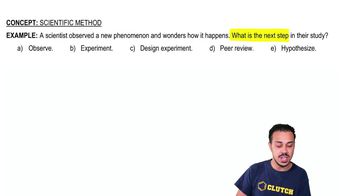
 01:35
01:35