 Indietro
General Biology Key Concepts
 09:50
09:50
Termini in questo insieme (40)
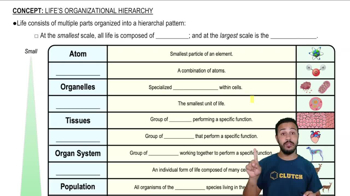
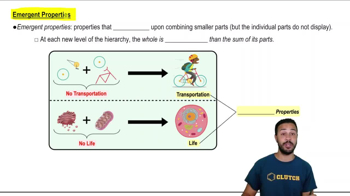
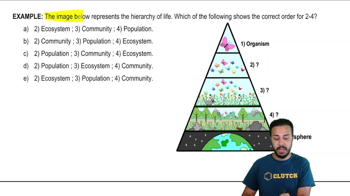
Atoms → Molecules → Organelles → Cells → Tissues → Organs → Organ Systems → Organism → Populations → Communities → Ecosystems → Biosphere
All organisms share DNA with 4 bases (Adenine, Thymine, Cytosine, Guanine) encoding proteins via the same amino acid code, indicating common evolutionary origin.
Reductionism: studying isolated parts of a system.
Systems Biology: studying interactions and dynamics of whole biological systems.
Both have cell membrane, DNA, cytoplasm, and ribosomes.
Prokaryotes lack membrane-bound nucleus and organelles; usually smaller and unicellular.
Eukaryotes have membrane-bound nucleus and organelles; often multicellular.
Bacteria (prokaryotic), Archaea (prokaryotic, often extremophiles), Eukarya (eukaryotic).
Animals, Plants, Fungi, Protists.
Multicellular and ingest food.
Multicellular autotrophs with cell walls made of cellulose.
Heterotrophs that absorb digested food; can be multicellular or unicellular.
Mostly unicellular with no common structure or feature.
Observation → Question → Hypothesis → Data Collection/Analysis → Conclusion.
Group kept under baseline conditions without treatment; used for comparison to isolate effects of the independent variable.
Independent: variable manipulated by researcher.
Dependent: variable measured as response.
Qualitative: descriptive, non-numerical (e.g., color).
Quantitative: numerical measurements (e.g., weight).
1st shell: max 2 electrons; 2nd shell: max 8 electrons; 3rd shell: max 8 electrons.
s orbital: spherical, holds 2 electrons.
p orbital: dumbbell-shaped, 3 orientations, holds 6 electrons total.
Atomic number = protons = electrons (neutral atom).
Atomic mass = protons + neutrons.
Atoms of the same element with same protons but different neutrons, thus different atomic masses.
Same number of valence electrons, leading to similar chemical properties and family grouping.
Atoms share one or more pairs of valence electrons to complete outer shells.
Electronegativity is an atom's pull on shared electrons.
Equal electronegativity → nonpolar bond; unequal → polar bond with partial charges.
Most electronegative: Oxygen (O), Nitrogen (N).
Least electronegative: Carbon (C), Hydrogen (H).
Attraction between a hydrogen with partial positive charge bound to O or N and another electronegative atom with partial negative charge.
Inert atoms have full outer shells.
Bond capacity equals number of electrons needed to fill shell.
Cations form by losing electrons; anions by gaining electrons.
Hydrophilic: polar/ionic, dissolve in water.
Hydrophobic: nonpolar, repel water.
Polar compounds form hydrogen bonds with water.
Ionic compounds are surrounded by hydration shells of water molecules.
Cohesion/adhesion, temperature moderation, expansion on freezing, and versatile solvent properties.
1 mole = molecular mass in grams = \(6.022 \times 10^{23}\) molecules (Avogadro's number).
Calculate molecular weight, multiply by molarity and volume, weigh solute, dissolve in solvent, adjust to final volume.
Strong acid: fully dissociates to release H+ (e.g., HCl).
Strong base: fully dissociates to release OH- or accept H+ (e.g., NaOH).
pH = -log10[H+]; acidic pH < 7, neutral = 7, basic > 7.
[H+] × [OH-] = \(10^{-14}\); changing one affects the other inversely.
Each pH unit change equals a 10-fold change in [H+]; e.g., pH 3 has 100 times more [H+] than pH 5.
Buffers resist pH changes by accepting or donating H+ ions to maintain stable conditions.
Carbon forms 4 covalent bonds, enabling complex, stable, diverse molecules like chains, branches, and rings.
Atomic number 6; 2 inner electrons, 4 valence electrons; tetravalent forming up to 4 covalent bonds.
Composed of C and H; C-H bonds are nonpolar due to similar electronegativities, making hydrocarbons hydrophobic.
Compounds with same formula but different structures.
Types: Structural, Cis-Trans, Enantiomers.
Hydroxyl (-OH): polar, alcohols.
Carbonyl (>C=O): polar, ketone/aldehyde.
Carboxyl (-COOH): acidic.
Amino (-NH2): basic.
Sulfhydryl (-SH): forms disulfide bridges.
Phosphate (-OPO2/3-): negative, energy transfer.
Methyl (-CH3): nonpolar, affects gene expression.