Skip to main content
General Biology
Il mio corso
Impara
Preparazione agli esami
AI Tutor
Guide di studio
Soluzioni per libri di testo
Flashcard
Esplora
Prova l'app
Il mio corso
Impara
Preparazione agli esami
AI Tutor
Guide di studio
Soluzioni per libri di testo
Flashcard
Esplora
Prova l'app
Indietro
General Biology: Key Concepts from Cell Biology, Biochemistry, and Molecular Biology
Puoi toccare per girare la carta.
What happens to the energy of motion when a bike stops coasting?
Puoi toccare per girare la carta.
👆
What happens to the energy of motion when a bike stops coasting?
It is
released as heat
due to friction and energy transformation.
Avanzamenti del tracciato
I pulsanti di controllo sono stati cambiati in modalità "navigazione".
1/45
Video consigliati
02:32
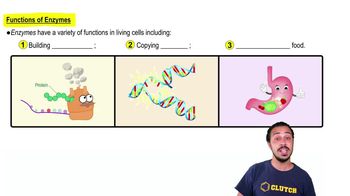
Functions of Enzymes
21896
views
338
rank
2
comments
02:25
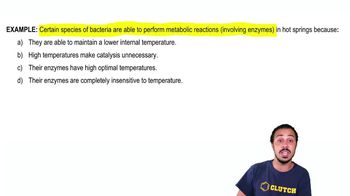
Enzymes Example 1
17703
views
221
rank
02:55
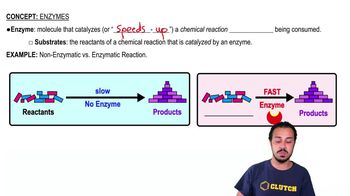
Enzymes
23958
views
411
rank
Termini in questo insieme (45)
Nascondere definizioni
What happens to the energy of motion when a bike stops coasting?
It is
released as heat
due to friction and energy transformation.
Which transport process matches the export of tears from cells?
Exocytosis
is the process of exporting substances from cells.
How do enzymes increase the rate of a reaction?
By
decreasing activation energy
required for the reaction.
What is the region of an enzyme where the substrate binds called?
The
active site
is where substrates bind to the enzyme.
How does an inhibitor affect enzyme function?
It
changes the enzyme's active site
, preventing substrate binding.
What happens when a balloon with 10% glucose is placed in 5% glucose solution and is permeable to water but not glucose?
Water moves into the balloon, increasing its volume due to osmosis.
What determines an enzyme's function?
An enzyme's function depends on its
three-dimensional shape
.
What energy transformation powers sperm swimming motion?
Sperm convert
chemical energy into kinetic energy
.
Define osmosis.
Osmosis is the
diffusion of water across a selectively permeable membrane
.
How is energy defined in biology?
Energy is the
capacity to cause change
or do work.
What is an isotonic solution relative to a cell?
A solution where the cell neither gains nor loses net water; concentrations are equal.
Diffusion is an example of what type of transport?
Passive transport
, moving substances down their concentration gradient without energy.
How does ATP perform cellular work?
ATP releases energy when it
loses a phosphate group
, converting to ADP.
What type of energy does an object at rest have?
It has
potential energy
due to its position or structure, but no kinetic energy.
How many calories are in 10 kilocalories?
10 kilocalories equal
10,000 calories
.
What happens during diffusion?
Particles spread from areas of
higher concentration to lower concentration
until equilibrium.
Which solution is hypertonic: 10% glucose inside a balloon or 5% glucose outside?
The 10% glucose solution inside the balloon is
hypertonic
relative to the 5% outside.
What compound directly provides energy for cellular work?
ATP
is the direct energy source for cellular processes.
How does RNA differ from DNA?
RNA contains
uracil
instead of thymine found in DNA.
What are saturated fats saturated with?
Saturated fats are saturated with
hydrogen atoms
and have only single bonds.
What type of reaction forms lactose from galactose and glucose?
A
dehydration
reaction forms lactose and water.
What is the state of a fat with only single bonds at room temperature?
It is
saturated and solid
at room temperature.
Steroids belong to which class of biomolecules?
Steroids are a type of
lipid
.
Which biomolecules are hydrophilic?
Carbohydrates
are hydrophilic due to their polar groups.
What elements do carbohydrates typically contain?
Carbohydrates contain
carbon, hydrogen, and oxygen
atoms.
What is the complementary DNA strand for GACGTCA?
The complementary strand is
CTGCAGT
.
What components do amino acids include?
Amino acids have a
central carbon, hydrogen atom, amino group, carboxyl group, and side chain
.
What nucleotides are found in DNA?
DNA contains
thymine, guanine, adenine, and cytosine
.
What are proteins polymers of?
Proteins are polymers made of
amino acid
monomers.
What distinguishes plant cells from animal cells?
Plant cells have a
cell wall and a central vacuole
.
What is the function of the plasma membrane?
It
regulates traffic of chemicals
in and out of the cell.
What organelles are part of the endomembrane system?
Golgi apparatus, lysosomes, vacuoles, and endoplasmic reticulum.
Where does protein synthesis occur?
Protein synthesis occurs on
ribosomes
.
What is the major function of chloroplasts?
Chloroplasts enable
photosynthesis
.
What type of cell has both a nucleus and a cell wall?
A
plant cell
.
How is information transferred from the nucleus to ribosomes?
Via
mRNA
.
What are the major lipids of plasma membranes?
Phospholipids
are the major lipids.
What type of cell lacks a nucleus?
A
prokaryotic cell
lacks a nucleus.
What are the four most common elements in living organisms?
Nitrogen (N), Oxygen (O), Carbon (C), and Hydrogen (H).
What defines an isotope of an element?
Same number of protons but different number of neutrons.
What is an ion?
An atom with an electrical charge due to unequal protons and electrons.
Why can some insects walk on water?
Because of water's
surface tension
from cohesive properties.
Why is water a polar molecule?
Oxygen has a slight negative charge; hydrogen has a slight positive charge.
In a sugar-coffee solution, what is the solvent?
Coffee is the
solvent
.
How many protons, neutrons, and electrons does an uncharged iodine atom have?
53 protons, 74 neutrons, and 53 electrons.
 IndietroIndietro
 02:32