Indietro

General Biology: Key Concepts from Chapters 1 and 2

I pulsanti di controllo sono stati cambiati in modalità "navigazione".
1/29
  • Seven properties of life

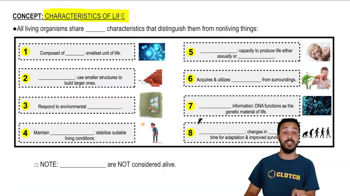
    Evolutionary adaptation, response to environment, biological order, self-regulation and homeostasis, reproduction, energy processing and metabolism, growth and development.
  • Emergent properties

    Qualities of living things that arise only at higher levels of biological organization, requiring a holistic view of organism parts.
  • Levels of biological organization

    Biosphere, ecosystem, community, population, organism, organs/organ systems, tissues, cells, organelles, molecules.
  • Theme: Evolution in biology

    Evolution accounts for the unity and diversity of life through descent with modification and natural selection.
  • Eukaryotic cell

    Cell type with membrane-bound organelles and DNA stored in a nucleus, often found in multicellular organisms.
  • Prokaryotic cell

    Smaller, simpler cells without a nucleus; organelles are free-floating.
  • DNA

    Double-helix molecule containing genetic instructions for protein production in all living organisms.
  • Gene

    Section of DNA within a chromosome that codes for a specific protein.
  • Genome

    The complete set of genes within a single organism.
  • Negative feedback

    Regulatory mechanism where the end product inhibits the process to maintain balance.
  • Positive feedback

    Regulatory mechanism where the end product amplifies the process.
  • Taxonomic hierarchy

    Species, Genus, Family, Order, Class, Phylum, Kingdom, Domain.
  • Three domains of life

    Bacteria, Archaea, and Eukarya.
  • Darwin's two main points

    Species evolve from common ancestors by descent with modification and adapt to their environment.
  • Natural selection

    Mechanism of evolution where favorable traits increase in frequency due to survival and reproduction advantages.
  • Scientific inquiry types

    Exploratory inquiry (observation-based) and hypothesis-based inquiry (testing predictions).
  • Hypothesis

    A testable and falsifiable proposed explanation for a natural phenomenon.
  • Controlled experiment

    An experiment where all variables except one are held constant to test the effect of that variable.
  • Matter

    Anything that has mass and takes up space, composed of chemical elements.
  • Four elements making up 96% of living matter

    Oxygen, Carbon, Hydrogen, Nitrogen.
  • Atom structure

    Protons and neutrons in nucleus; electrons orbit in shells.
  • Atomic number

    Number of protons in an atom's nucleus, defining the element.
  • Isotope

    Atoms of the same element with different numbers of neutrons.
  • Valence electrons

    Electrons in the outermost shell that determine chemical reactivity.
  • Covalent bond

    Chemical bond formed by sharing electron pairs between atoms.
  • Polar covalent bond

    Covalent bond with unequal sharing of electrons due to differing electronegativities.
  • Ionic bond

    Bond formed by transfer of electrons creating oppositely charged ions.
  • Hydrogen bond

    Weak attraction between a hydrogen atom in a polar covalent bond and a charged molecule.

  • Chemical reaction

    Process that makes or breaks chemical bonds, transforming reactants into products.