 Indietro
General Biology: Key Concepts from Chapters 5-7
 03:08

Termini in questo insieme (29)
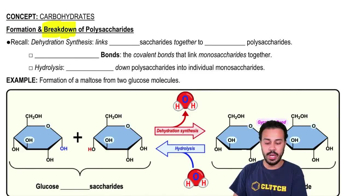
Dehydration reactions build polymers by removing water, while hydrolysis breaks polymers into monomers by adding water.
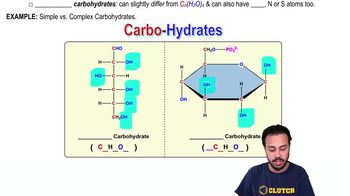
Aldose sugars have a carbonyl group at the end (aldehyde), ketose sugars have it within the carbon chain (ketone).
Both are glucose polymers, but starch is for energy storage in plants, glycogen is more branched and stored in animals.
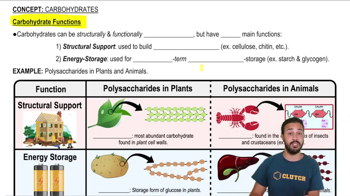
Cellulose and chitin are structural carbohydrates that build cell walls and exoskeletons rather than store energy.
Insoluble fiber like cellulose is indigestible because most animals lack enzymes to break its beta-glycosidic bonds.
Corn oil has more unsaturated fatty acids with kinks, preventing tight packing; lard has more saturated fats, making it solid.
Amphipathic means having both hydrophilic (polar head) and hydrophobic (nonpolar tails) regions, causing membrane formation.
All amino acids have an amino group, carboxyl group, hydrogen atom, and a variable R group attached to a central carbon.
Nucleotides have a phosphate group, pentose sugar, and nitrogenous base. DNA has deoxyribose and thymine; RNA has ribose and uracil.
Light microscopy allows live cell viewing but lower resolution; electron microscopy has high resolution but requires fixed, dead samples.
Cell fractionation separates cell components to study organelles individually.
Magnification enlarges image, resolution distinguishes details, and contrast differentiates structures.
Surface area to volume ratio limits cell size; cells must remain small for efficient nutrient and waste exchange.
All cells have a plasma membrane, cytoplasm, ribosomes, and DNA.
Prokaryotes lack a nucleus and membrane-bound organelles; eukaryotes have both.
Explains mitochondria and chloroplasts originated from engulfed prokaryotes living symbiotically inside eukaryotic cells.
Nuclear pores regulate transport of molecules like RNA and proteins between nucleus and cytoplasm.
Rough ER has ribosomes and synthesizes proteins; smooth ER lacks ribosomes and synthesizes lipids and detoxifies.
Mitochondria produce ATP via cellular respiration; malfunction leads to energy deficiency.
Motor proteins use ATP to move along cytoskeleton tracks, transporting vesicles and organelles.
Tight junctions seal cells, desmosomes anchor cells, and gap junctions allow communication.
Membranes are a fluid bilayer of phospholipids with embedded proteins forming a mosaic.
Membrane carbohydrates aid in cell recognition and adhesion.
Large, polar, or charged molecules cannot easily cross; small nonpolar molecules diffuse readily.
Diffusion is movement of solutes from high to low concentration; osmosis is diffusion of water across a membrane.
Cotransport uses the gradient of one molecule to drive transport of another against its gradient.
Pinocytosis engulfs fluids, phagocytosis engulfs large particles, and receptor-mediated is selective uptake via receptors.
Hypotonic: lower solute outside, water enters cell; isotonic: equal solute; hypertonic: higher solute outside, water leaves cell.
Uses ATP to pump 3 Na+ out and 2 K+ in, creating an electrochemical gradient.