 Indietro
General Biology: Key Concepts Review
 04:26
04:26
Termini in questo insieme (32)
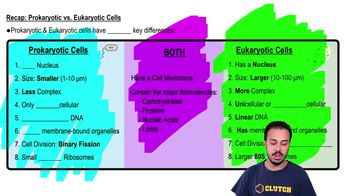
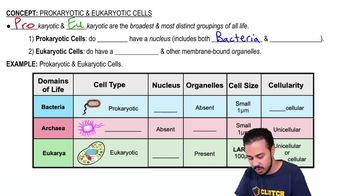
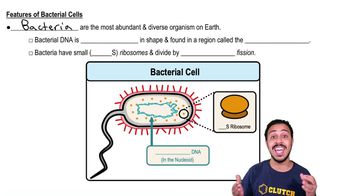
Prokaryotic cells lack a nucleus and membrane-bound organelles; eukaryotic cells have a nucleus and organelles.
Living organisms exhibit growth, reproduction, response to stimuli, metabolism, and homeostasis.
From simplest to complex: molecule, cell, tissue, organ, organ system, organism, population, community, ecosystem, biosphere.
Positive feedback amplifies changes; negative feedback reduces changes to maintain homeostasis.
Similarities in DNA, fossils, embryology, and homologous structures support common ancestry of all life.
Evolution is change in populations over time; natural selection is differential survival and reproduction of individuals.
Darwin proposed natural selection; Lamarck suggested inheritance of acquired traits.
Observation, Hypothesis, Experiment, Data Collection, Conclusion, and Communication.
The variable that is changed or manipulated in an experiment.
The variable that is measured or observed in response to changes in the independent variable.
A standard for comparison that does not receive the experimental treatment.
Showed that maggots on meat came from flies, disproving spontaneous generation.
Carbon (C), Hydrogen (H), Oxygen (O), and Nitrogen (N).
Atom: smallest unit of matter; Ion: charged atom; Isotope: atoms with same protons but different neutrons.
Protons (positive), Neutrons (neutral), Electrons (negative).
When their outer electron shell is full, usually 8 electrons (octet rule).
Polar covalent, non-polar covalent, ionic, and hydrogen bonds.
pH measures hydrogen ion concentration; lower pH is acidic, higher pH is basic.
Acids donate H+, Bases accept H+, Buffers resist pH changes.
High heat capacity, cohesion, adhesion, solvent ability, and ice floats due to lower density.
Ice is less dense than liquid water because of its crystalline hydrogen-bonded structure.
Hydrophobic: water-fearing, nonpolar; Hydrophilic: water-loving, polar or charged.
Solvent dissolves substances; Solution is a homogeneous mixture of solvent and solute.
Atmospheric gases trap heat, warming Earth; causes global warming.
Organic contain carbon-hydrogen bonds; Inorganic generally do not.
Can form four covalent bonds, allowing complex molecules and chains.
Isomers have same formula but different structures; enantiomers are mirror images.
Groups that affect molecule properties: amino (basic), methyl (nonpolar), carboxyl (acidic), hydroxyl (polar), sulfhydryl (stabilizes proteins).
ATP stores and transfers energy in cells.
Dehydration builds polymers by removing water; hydrolysis breaks polymers by adding water.
DNA is transcribed to RNA, which is translated to protein.
Carbohydrates - monosaccharides; Proteins - amino acids; Lipids - glycerol and fatty acids; Nucleic acids - nucleotides.