Skip to main content
General Biology
Il mio corso
Impara
Preparazione agli esami
AI Tutor
Guide di studio
Soluzioni per libri di testo
Flashcard
Esplora
Prova l'app
Il mio corso
Impara
Preparazione agli esami
AI Tutor
Guide di studio
Soluzioni per libri di testo
Flashcard
Esplora
Prova l'app
Indietro
General Biology Lab Exam 1 Study Guide
Puoi toccare per girare la carta.
What are the basic lab safety rules?
Puoi toccare per girare la carta.
👆
What are the basic lab safety rules?
Use proper PPE, follow disposal procedures, and maintain cleaning procedures to ensure safety.
Avanzamenti del tracciato
I pulsanti di controllo sono stati cambiati in modalità "navigazione".
1/19
Video consigliati
01:35
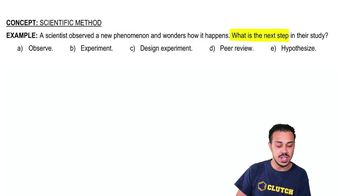
Scientific Method Example 1
13224
views
298
rank
03:03
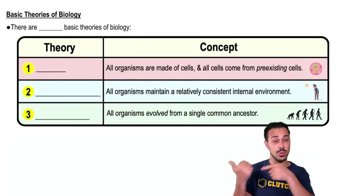
Basic Theories of Biology
14015
views
289
rank
1
comments
06:29
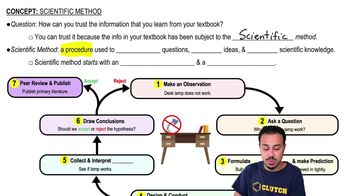
Scientific Method
22241
views
528
rank
1
comments
Termini in questo insieme (19)
Nascondere definizioni
What are the basic lab safety rules?
Use proper PPE, follow disposal procedures, and maintain cleaning procedures to ensure safety.
What does PPE stand for and why is it important?
PPE
stands for Personal Protective Equipment; it protects you from hazards in the lab.
What are proper disposal procedures in the lab?
Dispose of chemicals and biological materials according to lab guidelines to prevent contamination and accidents.
What are cleaning procedures in the lab?
Clean work surfaces and equipment after use to maintain a safe and contamination-free environment.
Define technology in the context of science.
Technology
is the application of scientific knowledge for practical purposes.
What is deductive science?
Deductive science
uses general principles to predict specific outcomes.
What is inductive science?
Inductive science
involves making generalizations based on specific observations.
What is pure science?
Pure science
is the pursuit of knowledge for its own sake without immediate practical application.
List the steps of the scientific method in order.
Observation, Question, Hypothesis, Experiment, Data Collection, Analysis, Conclusion.
What is the difference between a theory and a hypothesis?
A
hypothesis
is a testable prediction; a
theory
is a well-supported explanation based on evidence.
What is the boiling point of water?
The boiling point of water is \(100^{\circ}C\) at standard atmospheric pressure.
How many milligrams are in a gram?
There are 1000 milligrams in 1 gram.
Name the main parts of a microscope.
Eyepiece, objective lenses, stage, light source, coarse and fine focus knobs, arm, base.
What is the function of the eyepiece on a microscope?
The eyepiece magnifies the image formed by the objective lens.
What are macromolecules?
Macromolecules
are large molecules essential for life, including carbohydrates, lipids, proteins, and nucleic acids.
What substances do carbohydrates make up?
Carbohydrates are made of carbon, hydrogen, and oxygen and provide energy and structural support.
What are lipids composed of and their function?
Lipids are made mostly of carbon and hydrogen and store energy, form membranes, and act as signaling molecules.
What are proteins made of and their role?
Proteins are made of amino acids and perform structural, enzymatic, and regulatory functions.
What are nucleic acids and their function?
Nucleic acids like DNA and RNA store and transmit genetic information.
 IndietroIndietro
 01:35