 Indietro
General Biology Lab Exam Key Concepts
 06:35

Termini in questo insieme (28)
Accuracy means close to the correct value.
Precision means results are close/repeatable.
Ideal results are both accurate and precise.
Used to measure liquid volume.
Use the smallest appropriate micropipette for better precision.
P-10: 1–10 µL, P-100: 10–100 µL, P-1000: 100–1000 µL.
1 mL = 1000 µL
Water density is approximately 1 g/mL, so 5 mL water weighs 5 g.
Read the bottom of the meniscus at eye level for accurate volume measurement.
\(\%Error=\frac{|Experimental-Accepted|}{Accepted}\times100\)
\(Total\ Magnification=Ocular\times Objective\)
Ocular lens is 10×; multiply by objective lens.
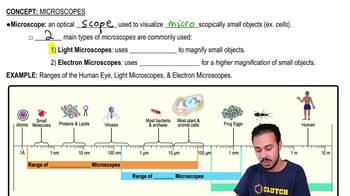
Compound: light from below, thin specimens, 2D image.
Dissecting: light reflects off, thick specimens, 3D image.
Measures absorbance or transmittance of light by a sample.
Wavelength where absorbance is highest.
The color you see is the color transmitted, not absorbed.
Example: Purple solution absorbs green light (~490–570 nm).
Carbohydrates, Lipids, Proteins, Nucleic acids.
Qualitative: Is it there? (color change)
Quantitative: How much is there? (numerical value)
Detects lipids; positive result is red-orange or greasy translucent spot.
Detects starch; positive result is blue-black or dark purple color.
Detects proteins by peptide bonds; positive result is purple color.
Movement of solute from high to low concentration.
Movement of water across a selectively permeable membrane toward higher solute concentration.
Less solute outside; water enters cell.
Animal cells may lyse; plant cells become turgid.
More solute outside; water leaves cell.
Animal cells crenate; plant cells plasmolyze.
Substances smaller than 13,000 Da can cross; glucose and iodine cross, starch and albumin do not.
Moves Na⁺ out and K⁺ in; requires ATP to maintain ion gradients.
\(C_1V_1=C_2V_2\)
Used to calculate concentrations after dilution.
\(y=mx+b\)
y = absorbance, x = concentration.
\(x=\frac{y-b}{m}\)
Plug in absorbance (y) to find concentration (x).
\(\%=\frac{grams}{mL}\times100\)
Grams of solute per 100 mL solution.
TDS = total dissolved solids; Hardness mainly from calcium and magnesium ions.