 Indietro
General Biology Lab Practical Review
 02:18

Termini in questo insieme (45)
Plasmolysis is the shrinking of a plant cell due to water loss when placed in a hypertonic solution.
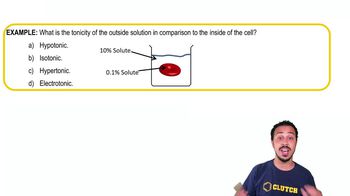
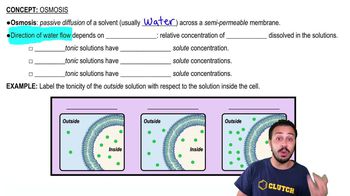
The concentration of solutes inside and outside the cell is equal, so there is no net movement of water.
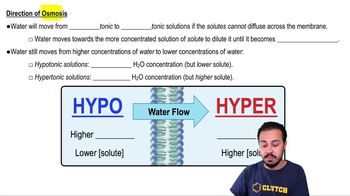
Osmosis is the diffusion of water across a semipermeable membrane.
The cell will gain water and swell; it will not lose water.
They will lyse (burst) because distilled water is hypotonic to the cells.
Protein synthesis is not a function of smooth ER; it is done by rough ER.
The fatty acid tails are hydrophobic.
It houses the cell's hereditary information (DNA).
Presence of ribosomes attached to its membrane.
They are involved in intracellular digestion.
Prokaryotic cells lack these structures.
The semifluid medium is called the cytosol.
Ribosomes are present in both cell types.
Plant cells have a cell wall.
Only water moves through the membrane.
The cell will gain water due to osmosis.
Solution B is also isotonic to solution A.
The plant cell will lose water and undergo plasmolysis.
Cellular respiration is aerobic, while fermentation is anaerobic.
The substrate binds to the enzyme's active site.
A dissecting light microscope is best suited for this purpose.
Total magnification is \(400X\).
Scanning: 4X, Low: 10X, High: 40X.
Prokaryotic cells are smaller and lack a nucleus; eukaryotic cells are larger with membrane-bound organelles and a nucleus.
Methylene blue is used for staining cheek cells.
Plant cells have a cell wall and chloroplasts.
Inputs: glucose and O2; Outputs: CO2, water, and ATP.
Soda lime absorbs CO2.
Mitochondria generate energy and are known as the "powerhouse of the cell."
They undergo crenation (shrinking).
Enzymes are composed of proteins.
It can change the enzyme's shape, preventing substrate binding and reducing enzyme activity.
They denature and lose function.
About \(40^{\circ}C\).
Making an observation.
An observation is a direct sensory input; an inference is a conclusion drawn from observations.
A hypothesis must be testable and falsifiable.
Little refocusing is needed when switching between objective lenses.
Electron microscopes use electrons as the source of illumination.
Competitive inhibitors bind to the active site, noncompetitive do not.
The Biuret test detects proteins and turns violet or purple.
It causes a decrease in oceanic pH (acidification).
Carbon has \(4\) valence electrons.
Nitrogen typically forms \(3\) bonds.
Oxygen has \(8\) neutrons.