Skip to main content
General Biology
Il mio corso
Impara
Preparazione agli esami
AI Tutor
Guide di studio
Soluzioni per libri di testo
Flashcard
Esplora
Prova l'app
Il mio corso
Impara
Preparazione agli esami
AI Tutor
Guide di studio
Soluzioni per libri di testo
Flashcard
Esplora
Prova l'app
Indietro
General Biology Lab Review
Puoi toccare per girare la carta.
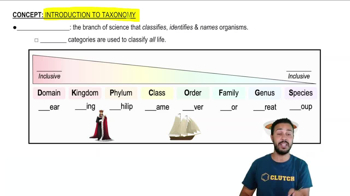
Levels of classification of living organisms
Puoi toccare per girare la carta.
👆
Levels of classification of living organisms
Organisms are classified from most broad to most specific levels.
Avanzamenti del tracciato
I pulsanti di controllo sono stati cambiati in modalità "navigazione".
1/20
Video consigliati
01:37
Introduction to Taxonomy Example 2
16158
views
335
rank
2
comments
05:48
Categorizing Life Based on Energy Acquisition
17573
views
426
rank
3
comments
02:23
Introduction to Taxonomy
29331
views
675
rank
2
comments
Termini in questo insieme (20)
Nascondere definizioni
Levels of classification of living organisms
Organisms are classified from most broad to most specific levels.
Using a dichotomous key
A tool used to identify organisms by answering a series of yes/no questions.
Bilateral symmetry
A body plan where the left and right sides of an organism are mirror images.
Correctly writing the scientific name
The genus name is capitalized and the species name is lowercase, both italicized.
Measuring using the metric system
Use metric units and lab equipment to measure length, mass, and volume accurately.
Conversions within the metric system
Convert between units like meters, centimeters, and millimeters using powers of ten.
Identification of variables in a scientific experiment
Determine independent, dependent, and controlled variables in an experiment.
Components of the scientific method
Includes observation, hypothesis, experiment, data collection, and conclusion.
Characteristics of enzymes as proteins
Enzymes are biological catalysts made of proteins that speed up chemical reactions.
Enzyme terminology
Terms include substrate, active site, enzyme-substrate complex, and product.
Materials, methods, and results from enzyme activity lab
Lab procedures to test enzyme function and measure reaction rates.
Benefits of using the metric system
Provides a standardized, decimal-based system for easy measurement and conversion.
Procedure results from scientific method lab
Record observations and data to support or refute the hypothesis.
Purpose of scientific experiments
To test hypotheses by controlling variables and collecting measurable data.
Scientific method lab activities
Hands-on experiments to practice hypothesis testing and data analysis.
Enzyme activity factors
Temperature, pH, and substrate concentration affect enzyme function.
Scientific experiment variables
Independent variable is changed; dependent variable is measured; controls stay constant.
Using lab equipment for measurement
Proper use of tools like rulers, pipettes, and balances for accurate data.
Scientific method steps
Observation, question, hypothesis, experiment, analysis, conclusion.
Enzyme lab observations
Note changes in reaction rate or product formation during enzyme tests.
 IndietroIndietro
 01:37
01:37