 Indietro
General Biology: Macromolecules
 01:17

Termini in questo insieme (20)
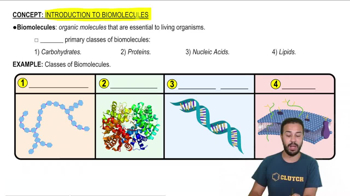
Macromolecules are large, complex molecules essential for life, typically composed of thousands of atoms.
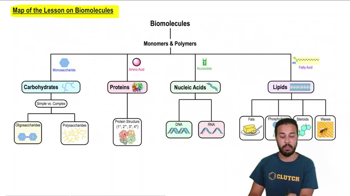
The four main types are carbohydrates, lipids, proteins, and nucleic acids.
Carbohydrates provide energy and structural support in cells.
Lipids store energy, make up cell membranes, and act as signaling molecules.
Proteins are polymers of amino acids linked by peptide bonds.
Nucleic acids store and transmit genetic information.
A monomer is a small molecule that can join with others to form a polymer.
A polymer is a large molecule made of repeating monomer units.
Polymers form through dehydration synthesis, which removes water to link monomers.
Polymers break down by hydrolysis, which uses water to split bonds.
An amino acid has an amino group, a carboxyl group, a hydrogen atom, and a variable R group attached to a central carbon.
A protein's function depends on its three-dimensional shape formed by amino acid sequence and folding.
Monosaccharides are simple sugars and the monomers of carbohydrates.
Sucrose (table sugar) is a common disaccharide made of two monosaccharides.
Cellulose provides structural support as a major component of plant cell walls.
Saturated fats have no double bonds in fatty acid chains; unsaturated fats have one or more double bonds.
Phospholipids form the bilayer of cell membranes, creating a barrier between inside and outside the cell.
Nucleotides consist of a sugar, a phosphate group, and a nitrogenous base.
DNA contains adenine, thymine, cytosine, and guanine.
Phosphodiester bonds link nucleotides in the DNA backbone.