 Indietro
General Biology: Macromolecules and Molecular Biology Basics
 03:08

Termini in questo insieme (41)
Macromolecules used mainly for energy and structure.
Macromolecules made of amino acids that perform many functions in cells.
Macromolecules including fats, oils, phospholipids, and steroids.
Macromolecules that store and transmit genetic information.
A small building block that can join to form a polymer.
A large molecule made of repeating smaller units called monomers.
Proteins that speed up chemical reactions.
Substances that speed up chemical reactions without being used up.
The molecule an enzyme acts on.
The temporary combination of an enzyme and its substrate.
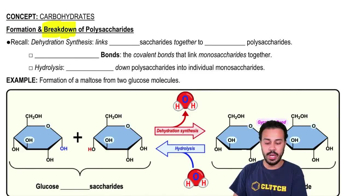
A reaction that joins molecules by removing water.
A reaction that breaks molecules apart by adding water.
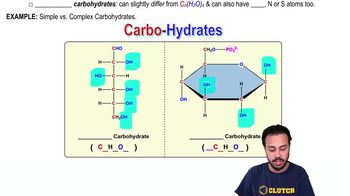
A single sugar molecule; the simplest carbohydrate.
A carbohydrate made of two monosaccharides.
A carbohydrate made of many sugar molecules.
A bond that connects sugar molecules.
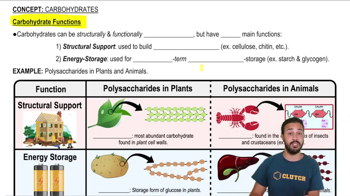
A plant polysaccharide used to store energy.
A polysaccharide used by animals to store glucose.
A structural polysaccharide found in plant cell walls.
A structural polysaccharide found in arthropod exoskeletons and fungal cell walls.
Lipids that are major components of cell membranes.
Lipids with a structure made of four connected rings.
Long hydrocarbon chains that are components of many lipids.
A fat with no carbon-carbon double bonds.
A fat with one or more carbon-carbon double bonds.
The monomer that makes up proteins.
The bond connecting amino acids in a protein.
The specific sequence of amino acids in a protein.
Local folding of a protein into shapes like alpha helices and beta sheets.
The overall three-dimensional shape of one polypeptide.
The structure formed when multiple polypeptide chains join together.
A change in a protein's shape that can cause it to lose its function.
A section of DNA that contains information for a functional product.
Messenger RNA; carries genetic instructions from DNA to ribosomes.
The monomer that makes up nucleic acids.
A nitrogen-containing part of a nucleotide.
A nitrogenous base with two rings, e.g., adenine and guanine.
A nitrogenous base with one ring, e.g., cytosine, thymine, uracil.
A bond that connects nucleotides in a nucleic acid strand.
The twisted ladder-shaped structure of DNA.
Describes DNA strands running in opposite directions.