Skip to main content
General Biology
Il mio corso
Impara
Preparazione agli esami
AI Tutor
Guide di studio
Soluzioni per libri di testo
Flashcard
Esplora
Prova l'app
Il mio corso
Impara
Preparazione agli esami
AI Tutor
Guide di studio
Soluzioni per libri di testo
Flashcard
Esplora
Prova l'app
Indietro
General Biology: Macromolecules and Their Functions
Puoi toccare per girare la carta.
What are the four categories of biological macromolecules?
Puoi toccare per girare la carta.
👆
What are the four categories of biological macromolecules?
Carbohydrates
,
Proteins
,
Lipids
, and
Nucleic acids
.
Avanzamenti del tracciato
I pulsanti di controllo sono stati cambiati in modalità "navigazione".
1/27
Video consigliati
01:17
Introduction to Biomolecules
30201
views
651
rank
4
comments
01:29
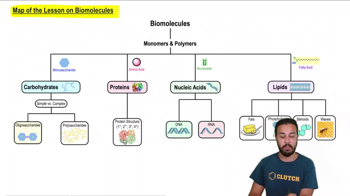
Map of the Lesson on Biomolecules
24790
views
824
rank
Termini in questo insieme (27)
Nascondere definizioni
What are the four categories of biological macromolecules?
Carbohydrates
,
Proteins
,
Lipids
, and
Nucleic acids
.
Define monomer and polymer in biological macromolecules.
A
monomer
is a single building block molecule; a
polymer
is many monomers covalently bonded together.
What is dehydration synthesis?
A reaction that covalently bonds monomers together by removing a water molecule.
What is hydrolysis?
A reaction that breaks polymers into monomers by adding a water molecule.
What defines organic compounds in biology?
Compounds that contain carbon, except carbon dioxide which is inorganic.
What is the monomer of carbohydrates?
A
monosaccharide
.
What is the chemical ratio of elements in carbohydrates?
Carbohydrates are made of carbon, hydrogen, and oxygen in a
1:2:1
ratio.
Name three polysaccharides and their functions.
Starch
stores energy in plants,
glycogen
stores energy in animals,
cellulose
provides plant cell wall structure.
What are lipids and their general property regarding water?
Lipids are large molecules that are
hydrophobic
(water-fearing) and do not mix with water.
Describe the structure of triglycerides.
A glycerol molecule covalently bonded to three fatty acids via dehydration synthesis.
Difference between saturated and unsaturated fats?
Saturated fats have only single bonds and are solid at room temperature; unsaturated fats have one or more double bonds causing bends and are liquid.
What are trans fats?
Artificially made fats where double bonds are broken and hydrogens added, making them unhealthy saturated fats.
Describe the structure and function of phospholipids.
Phospholipids have a glycerol, two fatty acids (hydrophobic tails), and a phosphate head (hydrophilic); they form cell membranes as bilayers.
What are steroids and their structure?
Hydrophobic lipids made of four fused carbon rings, including cholesterol and hormones.
What is the monomer of proteins?
An
amino acid
.
What groups are bonded to the central carbon in an amino acid?
A hydrogen, an amino group (-NH3), a carboxyl group (-COOH), and a variable side chain (R group).
What determines a protein's structure and function?
The
3D folding
of the protein, which is determined by amino acid sequence and interactions.
List the four levels of protein structure.
Primary (amino acid sequence), secondary (alpha helix or beta sheet), tertiary (3D folding), quaternary (multiple subunits).
What causes protein denaturation?
Heat, salt concentration changes, and strong acids or bases can cause loss of shape and function.
What are the two types of nucleic acids?
DNA
(deoxyribonucleic acid) and
RNA
(ribonucleic acid).
What is the monomer of nucleic acids?
A
nucleotide
, composed of sugar, phosphate, and nitrogenous base.
Name the nitrogenous bases in DNA and RNA.
DNA: adenine, thymine, cytosine, guanine; RNA: adenine, uracil, cytosine, guanine.
What is the shape of DNA?
A
double helix
.
What is the base pairing rule in DNA?
A pairs with T, and G pairs with C.
What is the base pairing rule between DNA and RNA?
DNA adenine pairs with RNA uracil; DNA guanine pairs with RNA cytosine.
What is the function of DNA?
Stores genetic information and instructions for making proteins.
How are the DNA backbone strands held together?
By covalent bonds between the sugar of one nucleotide and the phosphate of the next.
 IndietroIndietro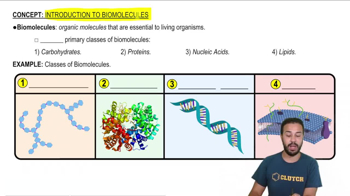
 01:17
01:17