Skip to main content
General Biology
Il mio corso
Impara
Preparazione agli esami
AI Tutor
Guide di studio
Soluzioni per libri di testo
Flashcard
Esplora
Prova l'app
Il mio corso
Impara
Preparazione agli esami
AI Tutor
Guide di studio
Soluzioni per libri di testo
Flashcard
Esplora
Prova l'app
Indietro
General Biology: Meiosis, Plant Life Cycles, and Reproduction
Puoi toccare per girare la carta.
When is the chromosome number reduced during meiosis?
Puoi toccare per girare la carta.
👆
When is the chromosome number reduced during meiosis?
During
anaphase I
of meiosis I, homologous chromosomes are separated, reducing the chromosome number from diploid (2n) to haploid (n).
Avanzamenti del tracciato
I pulsanti di controllo sono stati cambiati in modalità "navigazione".
1/17
Video consigliati
01:43
Introduction to Meiosis Example 1
11366
views
113
rank
04:49
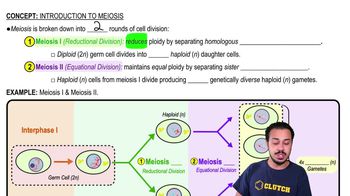
Meiosis I & Meiosis II
13557
views
156
rank
1
comments
04:33
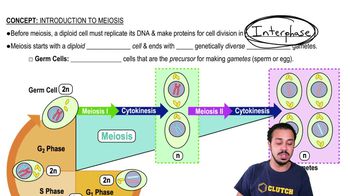
Introduction to Meiosis
15210
views
207
rank
Termini in questo insieme (17)
Nascondere definizioni
When is the chromosome number reduced during meiosis?
During
anaphase I
of meiosis I, homologous chromosomes are separated, reducing the chromosome number from diploid (2n) to haploid (n).
What happens to sister chromatids during meiosis II?
In meiosis II, sister chromatids are separated, similar to mitosis, but the chromosome number remains haploid.
What is alternation of generations in plants?
It is a life cycle alternating between a multicellular diploid
sporophyte
and a multicellular haploid
gametophyte
stage.
How do haploid gametophytes form in flowering plants after meiosis?
Haploid spores produced by meiosis undergo
mitosis
to form multicellular haploid gametophytes.
When does mitosis occur in the sporophyte generation?
The diploid sporophyte undergoes mitosis for growth and development, maintaining the diploid chromosome number.
When does meiosis occur in the sporophyte generation?
Meiosis occurs in specialized sporophyte cells to produce haploid spores that develop into gametophytes.
What features do all sexual life cycles share?
All involve
meiosis
to produce haploid cells and
fertilization
to restore diploidy, alternating between haploid and diploid stages.
What are advantages of asexual reproduction?
Asexual reproduction allows rapid population growth, requires less energy, and produces genetically identical offspring.
What are advantages of sexual reproduction?
Sexual reproduction increases genetic diversity, enhancing adaptability and survival in changing environments.
What does 'haploid multicellular organism' mean?
It refers to the
gametophyte
stage in plants and some algae, a multicellular organism with one set of chromosomes (n) producing gametes by mitosis.
What is a tetrad in meiosis?
A tetrad is a group of four chromatids formed by the pairing of two homologous chromosomes during prophase I.
What is synapsis during meiosis?
Synapsis is the pairing of homologous chromosomes during prophase I, enabling tetrad formation.
What is crossing over in meiosis?
Crossing over is the exchange of genetic material between non-sister chromatids of homologous chromosomes, increasing genetic diversity.
What are chiasmata?
Chiasmata are the physical sites where crossing over occurs between homologous chromosomes.
What is a polar body in mammalian oogenesis?
A polar body is a small cell produced during oogenesis that contains little cytoplasm and usually does not function as a gamete.
How many polar bodies are produced during mammalian egg development?
Typically, three polar bodies are produced during the two meiotic divisions of oogenesis.
Why are polar bodies formed during oogenesis?
Polar bodies form due to unequal cytoplasm division, ensuring the ovum retains most cytoplasm for development.
 IndietroIndietro
 01:43