 Indietro
General Biology: Membrane Structure, Metabolism, and Cellular Respiration
 02:21

Termini in questo insieme (18)
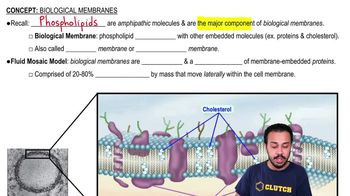
Describes the membrane as a flexible bilayer with embedded proteins and carbohydrates.
Carbohydrates play a key role in cell-cell recognition, such as blood types.
Movement of water across a membrane toward higher solute concentration.
Hypotonic: lower solute, Hypertonic: higher solute, Isotonic: equal solute concentration.
Phagocytosis: cell eating, Pinocytosis: cell drinking, Receptor-mediated endocytosis: specific uptake.
Confusing diffusion (solute movement) with osmosis (water movement).
Red blood cells placed in a hypotonic solution swell as water enters the cell.
All chemical reactions in an organism, divided into anabolic (building) and catabolic (breaking down) pathways.
Build complex molecules from simpler ones, e.g., protein synthesis.
Break down complex molecules, e.g., cellular respiration.
Energy cannot be created or destroyed, only transformed.
Biological catalysts that speed up reactions by lowering activation energy but do not change \(\Delta G\).
Occurs when all active sites are occupied; adding more enzyme increases reaction rate.
Each enzyme works best at a specific temperature.
End product inhibits an earlier enzyme in the pathway, preventing overproduction.
Enzymes do not alter \(\Delta G\); anabolic and catabolic pathways are distinct.
ATP inhibits phosphofructokinase in glycolysis via feedback inhibition.
Multi-stage process that converts glucose into ATP, the cell's energy currency.