Skip to main content
General Biology
Il mio corso
Impara
Preparazione agli esami
AI Tutor
Guide di studio
Soluzioni per libri di testo
Flashcard
Esplora
Prova l'app
Il mio corso
Impara
Preparazione agli esami
AI Tutor
Guide di studio
Soluzioni per libri di testo
Flashcard
Esplora
Prova l'app
Indietro
General Biology: Membrane Transport and Cell Signaling
Puoi toccare per girare la carta.
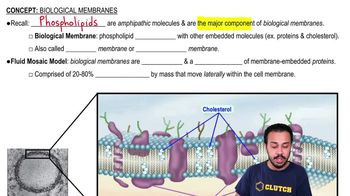
Phospholipids
Puoi toccare per girare la carta.
👆
Phospholipids
Molecules with a hydrophilic head and two hydrophobic tails that form the basic structure of cell membranes.
Avanzamenti del tracciato
I pulsanti di controllo sono stati cambiati in modalità "navigazione".
1/40
Video consigliati
02:21
Biological Membranes Example 1
24593
views
457
rank
1
comments
06:04
Biological Membranes
33724
views
684
rank
2
comments
Termini in questo insieme (40)
Nascondere definizioni
Phospholipids
Molecules with a hydrophilic head and two hydrophobic tails that form the basic structure of cell membranes.
Bilayer
Two layers of phospholipids arranged tail-to-tail forming the fundamental structure of membranes.
Fluid Mosaic
Model describing the membrane as a fluid combination of phospholipids, cholesterol, and proteins.
Selective permeability
Property of membranes allowing some substances to cross more easily than others.
Homeostasis
The maintenance of stable internal conditions despite external changes.
Electro-chemical gradient
Combined effect of chemical and electrical forces that drive ion movement across membranes.
Amphipathic
Molecules having both hydrophilic and hydrophobic regions, like phospholipids.
Saturated vs Unsaturated fatty acids
Saturated fatty acids have no double bonds and pack tightly; unsaturated have one or more double bonds causing kinks.
Cholesterol in membranes
A lipid that stabilizes membrane fluidity by preventing tight packing of phospholipids.
Membrane proteins / Integral proteins
Proteins embedded in the membrane that assist in transport, signaling, and structural support.
Major functions of membrane proteins
Transport, enzymatic activity, signal transduction, cell-cell recognition, intercellular joining, and attachment to cytoskeleton.
Glycoproteins and glycolipids
Membrane molecules with carbohydrate chains important for cell recognition and signaling.
Gradient
A difference in concentration or charge that drives movement of substances across membranes.
Osmosis
Diffusion of water across a selectively permeable membrane from low to high solute concentration.
Osmoregulation
Control of water balance within a cell or organism to maintain homeostasis.
Tonicity: hypertonic, hypotonic
Hypertonic solutions cause cells to lose water; hypotonic solutions cause cells to gain water.
Diffusion
Passive movement of molecules from high to low concentration.
Passive vs active transport
Passive transport requires no energy; active transport requires energy to move substances against gradients.
Channel proteins, pores, carrier proteins, gated ion channels
Membrane proteins that facilitate selective transport of ions and molecules.
Electrogenic pumps
Transport proteins that generate voltage across membranes by moving ions.
Sodium-potassium pump
An electrogenic pump that moves 3 Na+ out and 2 K+ into the cell using ATP.
Proton pump
An electrogenic pump that moves H+ ions across membranes to create a proton gradient.
Membrane potential
Voltage difference across a membrane due to ion distribution.
Cotransport
Coupled transport of two substances across a membrane by one protein.
Uniporter, symporter, antiporter
Uniporter transports one molecule; symporter transports two in the same direction; antiporter transports two in opposite directions.
Bulk transport: endocytosis and exocytosis
Processes that move large molecules or particles into (endocytosis) or out of (exocytosis) the cell.
Phagocytosis and pinocytosis
Phagocytosis engulfs large particles; pinocytosis takes in fluids and dissolved substances.
Intercellular vs intracellular signaling
Intercellular signaling occurs between cells; intracellular signaling occurs within a cell.
Autocrine signaling
Cells respond to signals they themselves release.
Paracrine signaling
Signals affect nearby cells.
Synaptic signaling
Neurons release neurotransmitters to signal adjacent cells across synapses.
Endocrine signaling
Hormones travel through the bloodstream to distant target cells.
Signal transduction
Process by which a signal is converted into a cellular response.
Ligands and receptors
Ligands are signaling molecules that bind to specific receptors to initiate signaling.
G protein-coupled receptors
Membrane receptors that activate G proteins to relay signals inside the cell.
Intracellular receptors
Receptors located inside the cell that bind ligands that cross the membrane.
Signal amplification
Process where a small signal triggers a large cellular response.
Phosphorylation, kinase, phosphatase
Kinases add phosphate groups to proteins; phosphatases remove them, regulating activity.
Second messengers
Small molecules like cyclic AMP that relay signals inside the cell.
Cyclic AMP
A common second messenger that activates protein kinase A to propagate signals.
 IndietroIndietro
 02:21