Indietro

General Biology: Membrane Transport, Metabolism, Respiration, and Photosynthesis

I pulsanti di controllo sono stati cambiati in modalità "navigazione".
1/35
  • Fluid mosaic model

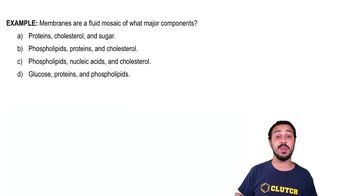
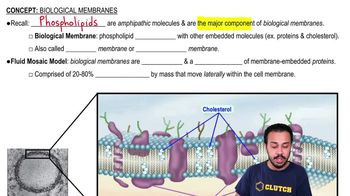
    Describes the membrane as a flexible phospholipid bilayer with various proteins embedded or attached.
  • Phospholipid amphipathic nature

    Phospholipids have hydrophilic heads facing water and hydrophobic tails pointing inward, away from water.
  • Integral vs peripheral proteins

    Integral proteins are embedded in the bilayer; peripheral proteins attach to the membrane surface.
  • Six major membrane protein functions

    Transport, enzymatic activity, signal transduction, cell-cell recognition, intercellular joining, attachment to cytoskeleton/ECM.
  • Membrane fluidity factors

    Affected by temperature, cholesterol, and tail saturation; unsaturated tails increase fluidity, cholesterol buffers fluidity.
  • Selective permeability

    Membrane allows some substances to cross more easily; small nonpolar molecules cross readily, ions and polar molecules do not.
  • Channel vs carrier proteins

    Channels form hydrophilic passageways; carriers bind substances and change shape to transport them.
  • Osmosis

    Net movement of water across a selectively permeable membrane toward higher solute concentration.
  • Effects of hypotonic, isotonic, and hypertonic solutions on cells

    Hypotonic: water enters (animal cells may lyse, plant cells become turgid); isotonic: no net water movement; hypertonic: water leaves (animal cells shrivel, plant cells plasmolyze).
  • Facilitated diffusion

    Passive transport using channel or carrier proteins moving substances down their concentration gradient without energy.
  • Active transport

    Moves substances against their gradient using energy, often ATP.
  • Sodium–potassium pump

    Uses ATP to move 3 Na⁺ out and 2 K⁺ into the cell, maintaining ion gradients and membrane potential.
  • Membrane potential and electrogenic pumps

    Voltage difference across membrane; electrogenic pumps create voltage by moving unequal charges.
  • Cotransport

    Uses downhill movement of one substance to drive uphill transport of another.
  • Bulk transport: exocytosis and endocytosis

    Exocytosis releases vesicle contents outside; endocytosis encloses material in vesicles to bring into the cell.
  • Cell signaling stages

    Reception (ligand binds receptor), transduction (signal relayed inside cell), response (cell changes activity).
  • Types of cell-surface receptors

    G protein-coupled receptors (GPCRs) and ligand-gated ion channels.
  • Role of kinases, phosphatases, and cAMP

    Kinases add phosphate groups; phosphatases remove them; cAMP acts as a second messenger in signaling.
  • Metabolism definition

    The complete set of chemical reactions in an organism, including catabolic and anabolic pathways.
  • Catabolic vs anabolic pathways

    Catabolic pathways break down molecules and release energy; anabolic pathways build molecules and require energy.
  • First and second laws of thermodynamics

    Energy is conserved (not created or destroyed); entropy increases in every energy transfer.
  • Free energy (G) and ΔG

    Free energy is energy available to do work; ΔG < 0 means exergonic/spontaneous; ΔG > 0 means endergonic/nonspontaneous.
  • ATP structure and function

    Composed of adenine, ribose, and three phosphate groups; hydrolysis releases energy used to drive cellular work.
  • Enzyme function and activation energy

    Enzymes lower activation energy to speed reactions without changing ΔG or equilibrium.
  • Competitive vs noncompetitive inhibitors

    Competitive inhibitors bind active site; noncompetitive bind elsewhere and reduce enzyme activity.
  • Feedback inhibition

    End product of a pathway inhibits an earlier enzyme to regulate the pathway.
  • Overall aerobic respiration equation

    \(\mathrm{C_6H_{12}O_6 + 6 O_2 \rightarrow 6 CO_2 + 6 H_2O + energy}\)
  • Stages of cellular respiration and locations

    Glycolysis (cytosol), pyruvate oxidation (mitochondrial matrix), citric acid cycle (matrix), oxidative phosphorylation (inner mitochondrial membrane).
  • Difference between substrate-level and oxidative phosphorylation

    Substrate-level transfers phosphate directly to ADP; oxidative phosphorylation uses ETC and proton gradient to make ATP.
  • Fermentation purpose and ATP yield

    Regenerates NAD⁺ to allow glycolysis to continue; produces no ATP beyond glycolysis's net 2 ATP.
  • Photosynthesis overall equation

    \(6 CO_2 + 6 H_2O + light \rightarrow C_6H_{12}O_6 + 6 O_2\)
  • Light reactions vs Calvin cycle locations and functions

    Light reactions occur in thylakoid membranes producing ATP, NADPH, and O₂; Calvin cycle occurs in stroma fixing CO₂ into sugars.
  • Role of photosystems II and I

    PSII splits water and starts electron flow; PSI helps reduce NADP⁺ to NADPH.
  • Chemiosmosis in chloroplasts vs mitochondria

    Both use H⁺ gradients and ATP synthase; chloroplasts pump H⁺ into thylakoid space, mitochondria into intermembrane space.
  • C3, C4, and CAM plant strategies

    C3 fixes CO₂ directly; C4 separates fixation and Calvin cycle in different cells; CAM fixes CO₂ at night to reduce water loss.