 Indietro
General Biology: Metabolism and Cellular Respiration
 02:17

Termini in questo insieme (30)
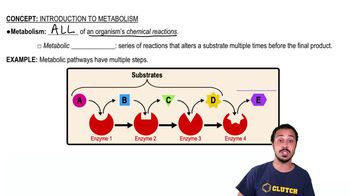
Metabolism is the sum of all chemical reactions in an organism that transform matter and energy to sustain life.
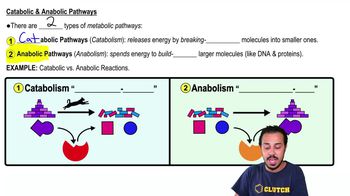
Exergonic reactions release energy, while endergonic reactions store energy.
Enzymes are proteins that lower the activation energy of chemical reactions, speeding them up to support life.
Energy is transferred or transformed but not created or destroyed; cells transform energy in metabolic processes.
Entropy of a closed system increases over time; living organisms are open systems that exchange energy to maintain order.
Energy is stored in the chemical bonds of molecules, especially in high-energy phosphate bonds like those in ATP.
A negative ΔG means the reaction is spontaneous and releases energy (exergonic).
Endergonic reactions are often coupled with exergonic reactions to drive energy-requiring processes.
ATP has three phosphate groups with high-energy bonds, especially the bond to the 3rd phosphate, which releases energy when broken.
ATP is hydrolyzed to ADP and inorganic phosphate, releasing energy; ADP is then recycled to ATP using energy from cellular respiration.
Enzymes lower the activation energy needed to start a reaction, increasing reaction rate without changing ΔG.
The substrate is the molecule an enzyme acts on; the active site is the enzyme region where the substrate binds.
Induced fit is the enzyme's active site changing shape to better bind the substrate and catalyze the reaction.
Enzymes: 1) Orient substrates correctly, 2) Strain substrate bonds, 3) Provide a favorable microenvironment, 4) Covalently bond to substrate.
Temperature and pH affect enzyme shape and function; extremes can denature enzymes and reduce reaction rates.
Competitive inhibitors bind the active site; noncompetitive inhibitors bind elsewhere, altering enzyme shape.
To control metabolic pathways, conserve energy, and respond to environmental changes.
1) Gene regulation, 2) Enzyme activation/deactivation, 3) Feedback inhibition, 4) Localization and compartmentalization.
\(\mathrm{C_6H_{12}O_6 + 6O_2 \rightarrow 6CO_2 + 6H_2O + energy}\); it is an exergonic reaction.
Oxidation is loss of electrons; reduction is gain of electrons. Glucose is oxidized; oxygen is reduced.
Multiple steps allow controlled energy release and efficient ATP production rather than one explosive reaction.
In eukaryotes, glycolysis occurs in the cytoplasm; in prokaryotes, also in the cytoplasm.
Inputs: glucose, 2 ATP, 2 NAD+; Outputs: 2 pyruvate, 4 ATP (net 2 ATP), 2 NADH.
In aerobic respiration, NADH donates electrons to the electron transport chain; in fermentation, NADH is oxidized back to NAD+ to sustain glycolysis.
In the mitochondrial matrix of eukaryotic cells.
Carbon dioxide, NADH, FADH2, and ATP (or GTP).
They shuttle electrons to the electron transport chain, becoming oxidized back to NAD+ and FAD.
In the inner mitochondrial membrane.
Movement of protons down their gradient through ATP synthase to produce ATP.
By uncoupling oxidative phosphorylation, allowing protons to flow without ATP synthesis, releasing energy as heat.