 Indietro
General Biology: Metabolism and Enzymes
 02:17

Termini in questo insieme (23)
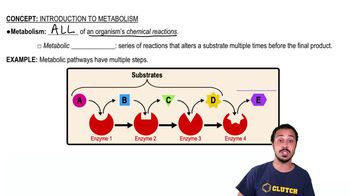
Metabolism is the sum of all chemical reactions in an organism that transform matter and energy, enabling life processes.
1. Life requires chemical reactions (making/breaking covalent bonds).
2. Some reactions release energy (exergonic), others store energy (endergonic).
3. Enzymes lower activation energy to speed reactions.
Energy is transferred or transformed but cannot be created or destroyed.
Examples include chemical energy in ATP hydrolysis, kinetic energy in molecular movement, and potential energy stored in chemical bonds.
Energy is stored in the chemical bonds of molecules.
Entropy (disorder) of a closed system increases over time.
No, organisms are open systems exchanging energy and matter with their environment, allowing them to maintain order.
Energy lost as heat increases entropy in the environment; it is not destroyed but dispersed.
Organisms transform energy (1st law) and increase entropy in their surroundings (2nd law) while maintaining internal order.
A negative ΔG means the reaction is exergonic and occurs spontaneously, releasing energy.
A positive ΔG means the reaction is endergonic, requiring energy input to proceed.
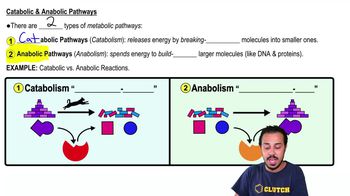
Anabolic reactions build molecules and are endergonic.
Catabolic reactions break down molecules and are exergonic.
Coupling allows energy released from exergonic reactions to drive endergonic reactions, making processes efficient.
ATP has three phosphate groups with high-energy bonds, especially the bond to the 3rd phosphate, which releases energy when broken.
ATP is hydrolyzed to ADP and inorganic phosphate, releasing energy; ADP is then recycled back to ATP using energy from food.
Enzymes lower the activation energy needed for reactions, speeding up the reaction without changing ΔG.
The enzyme changes shape slightly to fit the substrate snugly at the active site, enhancing catalysis.
1. Orienting substrates correctly
2. Straining substrate bonds
3. Providing a favorable microenvironment
4. Covalently bonding to substrate
Extreme temperature or pH can denature enzymes or alter active site shape, reducing activity.
Competitive inhibitors bind the active site; noncompetitive inhibitors bind elsewhere, changing enzyme shape.
Copper acted as a competitive inhibitor for catalase.
To control metabolic pathways, conserve energy, and respond to environmental changes.
1. Gene regulation
2. Enzyme activation/deactivation
3. Feedback inhibition
4. Localization and compartmentalization