 Indietro
General Biology: Metabolism, Cellular Respiration, and Photosynthesis
 01:53

Termini in questo insieme (24)
Metabolism is the sum of all chemical reactions that occur within a cell or organism to maintain life, including catabolic and anabolic pathways.
Catabolic pathways break down molecules to release energy, while anabolic pathways build complex molecules using energy.
Kinetic energy is energy of motion, thermal energy is heat, potential energy is stored energy, and chemical energy is energy stored in chemical bonds.
Free energy (G) is the energy available to do work in a system; changes in free energy determine if a reaction is spontaneous.
The first law states energy cannot be created or destroyed. The second law states entropy (disorder) of the universe increases over time.
Entropy is a measure of disorder or randomness in a system, which tends to increase in spontaneous processes.
Exergonic reactions release energy and are spontaneous; endergonic reactions require energy input and are non-spontaneous.
ATP (adenosine triphosphate) stores and transfers energy; it couples exergonic and endergonic reactions by transferring phosphate groups.
A phosphorylated intermediate is a molecule with a phosphate group covalently bonded, making it more reactive in metabolic reactions.
Enzymes lower the activation energy by stabilizing the transition state and providing an active site for substrates to bind.
Feedback inhibition is when the end product of a metabolic pathway inhibits an enzyme early in the pathway to regulate its own production.
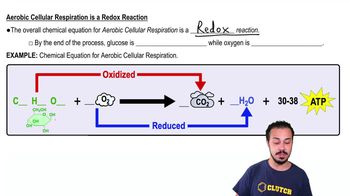
Cellular respiration: \(\mathrm{C_6H_{12}O_6 + 6O_2 \rightarrow 6CO_2 + 6H_2O + energy}\)
Oxidation is loss of electrons; reduction is gain of electrons in redox reactions.
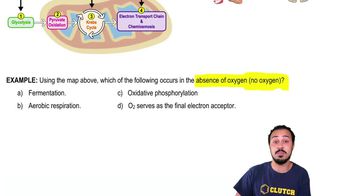
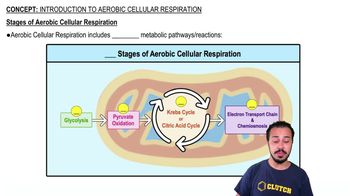
Glycolysis breaks glucose into two pyruvate molecules, producing a net gain of 2 ATP and 2 NADH molecules.
Acetyl CoA is formed from pyruvate oxidation and enters the citric acid cycle to be further oxidized for energy extraction.
The cycle starts with Acetyl CoA combining with oxaloacetate to form citrate.
It occurs in the inner mitochondrial membrane and produces ATP using the electron transport chain and chemiosmosis.
Oxygen acts as the final electron acceptor, combining with electrons and protons to form water.
NAD+ is the oxidized form; NADH is the reduced form carrying electrons after glycolysis and the citric acid cycle.
Fermentation regenerates NAD+ from NADH allowing glycolysis to continue, producing 2 ATP per glucose without oxygen.
Light reactions convert light energy into chemical energy (ATP and NADPH) and release oxygen from water.
The Calvin cycle fixes carbon dioxide into sugars using ATP and NADPH; it is called a dark reaction because it does not require light directly.
Photosystems are protein-pigment complexes that capture light energy to drive electron transport in photosynthesis.
A photon is a particle of light that carries energy used in photosynthesis.