Skip to main content
General Biology
Il mio corso
Impara
Preparazione agli esami
AI Tutor
Guide di studio
Soluzioni per libri di testo
Flashcard
Esplora
Prova l'app
Il mio corso
Impara
Preparazione agli esami
AI Tutor
Guide di studio
Soluzioni per libri di testo
Flashcard
Esplora
Prova l'app
Indietro
General Biology: Molecules of Cells and Cell Structure
Puoi toccare per girare la carta.
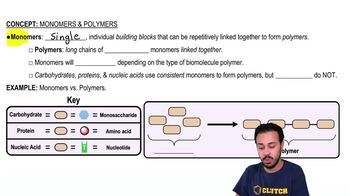
What are monomers and polymers in biological molecules?
Puoi toccare per girare la carta.
👆
What are monomers and polymers in biological molecules?
Monomers
are small molecules, and
polymers
are large macromolecules made of monomers linked together.
Avanzamenti del tracciato
I pulsanti di controllo sono stati cambiati in modalità "navigazione".
1/24
Video consigliati
04:19
Building & Breaking-Down Polymers
27070
views
488
rank
3
comments
03:42
Monomers & Polymers
30466
views
669
rank
2
comments
Termini in questo insieme (24)
Nascondere definizioni
What are monomers and polymers in biological molecules?
Monomers
are small molecules, and
polymers
are large macromolecules made of monomers linked together.
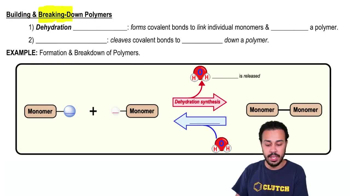
What is dehydration synthesis?
A chemical reaction that
forms a new bond
between monomers by removing water.
What is hydrolysis?
A reaction that
breaks bonds
between monomers by adding water.
What is the primary function of carbohydrates?
Carbohydrates provide
quick and short-term energy storage
.
Name the three types of carbohydrates based on size.
Monosaccharides
(simple sugars),
disaccharides
, and
polysaccharides
.
What are examples of carbohydrate storage molecules in plants and animals?
Starch
in plants and
glycogen
in animals.
What are cellulose and chitin?
They are
structural carbohydrates
in plants (cellulose) and animals/fungi (chitin).
What are lipids and their solubility property?
Lipids are molecules that
do not dissolve in water
(hydrophobic).
What are the functions of fats?
Fats provide
long-term energy storage
,
insulation
, and
organ protection
.
What is the difference between saturated and unsaturated fatty acids?
Saturated
fatty acids have no double bonds;
unsaturated
fatty acids have one or more double bonds.
What is a triglyceride?
A lipid made of
three fatty acids
linked to a glycerol molecule.
What are proteins made of?
Proteins are polymers of
amino acids
linked by
peptide bonds
.
What is a peptide bond?
A chemical bond that
joins two amino acids
together.
List the four levels of protein structure.
Primary
,
secondary
,
tertiary
, and
quaternary
structures.
What are nucleotides composed of?
A
phosphate group
, a
sugar
, and a
nitrogenous base
.
What are the two main types of nucleic acids?
DNA
and
RNA
.
What is ATP and its function?
Adenosine triphosphate
is an energy carrier that releases energy when broken down.
What is the plasma membrane composed of?
A
phospholipid bilayer
with embedded proteins.
What is the function of the nucleus?
Stores
genetic information
and controls cell activities.
Name three membranous organelles involved in macromolecule processing.
Endoplasmic reticulum
,
Golgi apparatus
, and
lysosomes
.
What is the function of mitochondria?
They perform
aerobic cellular respiration
to produce energy.
What is the role of chloroplasts?
Carry out
photosynthesis
to convert light energy into glucose.
What are the three types of cytoskeletal fibers?
Actin filaments
,
intermediate filaments
, and
microtubules
.
What are cilia and flagella?
Cellular appendages that enable
movement
.
 IndietroIndietro
 04:19