Skip to main content
General Biology
Il mio corso
Impara
Preparazione agli esami
AI Tutor
Guide di studio
Soluzioni per libri di testo
Flashcard
Esplora
Prova l'app
Il mio corso
Impara
Preparazione agli esami
AI Tutor
Guide di studio
Soluzioni per libri di testo
Flashcard
Esplora
Prova l'app
Indietro
General Biology: Molecules of Cells - Carbohydrates and Organic Chemistry
Puoi toccare per girare la carta.
How many bonds can a carbon atom form?
Puoi toccare per girare la carta.
👆
How many bonds can a carbon atom form?
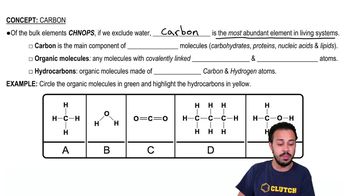
Carbon
can form
four covalent bonds
due to its four valence electrons.
Avanzamenti del tracciato
I pulsanti di controllo sono stati cambiati in modalità "navigazione".
1/20
Video consigliati
03:35
Carbon is an Excellent Building Block
22643
views
902
rank
04:19
Carbon
29817
views
705
rank
2
comments
Termini in questo insieme (20)
Nascondere definizioni
How many bonds can a carbon atom form?
Carbon
can form
four covalent bonds
due to its four valence electrons.
What are hydrocarbons?
Hydrocarbons
are organic molecules consisting only of
carbon and hydrogen
atoms.
What is a polymer?
A
polymer
is a long molecule made of many similar or identical
monomers
joined by covalent bonds.
What is dehydration synthesis?
A
dehydration reaction
joins two molecules covalently by
removing a water molecule
.
What is hydrolysis?
Hydrolysis
breaks bonds between molecules by
adding water
, separating polymers into monomers.
What is a monosaccharide?
A
monosaccharide
is the monomer of carbohydrates, usually a multiple of
CH2O
, like glucose (C6H12O6).
What functional groups are present in monosaccharides?
Monosaccharides contain a
carbonyl group
and several
hydroxyl groups
.
What is a disaccharide?
A
disaccharide
consists of two monosaccharides joined by a
glycosidic linkage
formed by dehydration.
What is a polysaccharide?
A
polysaccharide
is a carbohydrate polymer of hundreds to thousands of monosaccharides joined by glycosidic linkages.
What are the main functions of polysaccharides?
Polysaccharides serve for
energy storage
and
structural support
in cells.
How are polysaccharides broken down into monosaccharides?
Polysaccharides are broken down by
hydrolysis
, which adds water to break glycosidic bonds.
What is the difference between glucose and fructose structures?
Glucose has a
carbonyl group at the end
(aldehyde), fructose has it
within the chain
(ketone).
What is a glycosidic linkage?
A
glycosidic linkage
is a covalent bond formed between two sugar molecules by dehydration.
What is the role of functional groups in organic molecules?
Functional groups like
hydroxyl, carbonyl, carboxyl, amino, phosphate, and methyl
determine molecule properties and reactions.
What is the structure of methane (CH4)?
Methane has a
tetrahedral shape
with carbon at the center bonded to four hydrogens.
What types of carbon skeleton variations exist?
Carbon skeletons vary by
length, branching, double bonds, and rings
.
What is the difference between saturated and unsaturated hydrocarbons?
Saturated hydrocarbons have
single bonds
, unsaturated have
one or more double bonds
.
What is the significance of carbon rings in organic molecules?
Carbon skeletons can form
rings
, which are common in biological molecules like glucose and benzene.
What is the difference between dehydration synthesis and hydrolysis?
Dehydration synthesis
forms bonds by removing water;
hydrolysis
breaks bonds by adding water.
What is the monomer and polymer of carbohydrates?
Monomer:
Monosaccharide
; Polymer:
Polysaccharide
; Bond:
Glycosidic linkage
.
 IndietroIndietro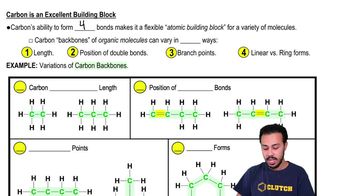
 03:35
03:35