 Indietro
General Biology: Natural Selection and Evidence for Evolution
 07:48

Termini in questo insieme (20)
Typological thinking views each species as an unchanging, perfect type; individual differences are unimportant.
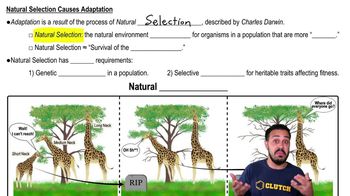
Darwinian evolution explains species change through time by natural selection acting on heritable variation within populations.
The fossil record shows a change in life over time, including extinct species and transitional features linking ancestors to descendants.
Vestigial traits are structures with no apparent modern function, like the human tailbone, indicating evolutionary history.
Homology refers to shared ancestral traits among species, supporting common ancestry.
1) Variation exists in a population. 2) Some variation is heritable. 3) More offspring are produced than survive. 4) Survival and reproduction are nonrandom.
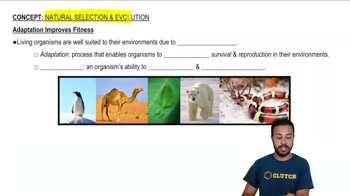
Fitness is an individual's ability to survive and reproduce relative to others in the population.
An adaptation is a heritable trait that increases fitness in a specific environment compared to individuals without it.
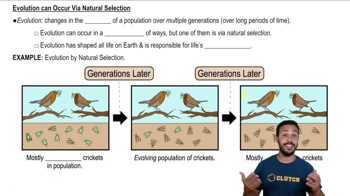
Selection determines which individuals survive and reproduce, but evolutionary change is seen as changes in trait frequencies in populations over generations.
Physiological changes occur within an individual's lifetime and are not inherited; evolutionary changes occur across generations and involve changes in allele frequencies.
Increased red blood cell production at high altitude is a physiological change in an individual, not evolution.
Tibetan populations have a high frequency of an EPAS1 allele that helps cope with low oxygen, an evolutionary adaptation.
Mutations occur randomly; natural selection sorts existing variation without foresight or planning.
Showed antibiotic resistance mutations exist before exposure, disproving the idea that bacteria mutate 'in order to' resist antibiotics.
Constraints include history, trade-offs, limited variation, and changing environments.
Human airway and food pipe cross in the throat, inherited from fish-like ancestors, causing choking risk.
Beak size favored in drought years differs from wet years, showing adaptation trade-offs depending on environment.
Natural selection can only act on existing heritable variation; no variation means no evolutionary response.
Organisms are adapted to past conditions; rapid environmental changes can outpace natural selection.
Natural selection increases frequency of heritable traits that improve fitness in the current environment but does not produce perfect organisms or work with foresight.