 Indietro
General Biology: Nature of Science and Basic Concepts
 01:35
01:35
Termini in questo insieme (20)
The primary goal of science is to form theories, which are explanations based on evidence collected from many tested hypotheses.
Hypothesis: A testable and falsifiable proposed explanation or prediction.
Theory: Well-supported explanations of why and how things happen.
Law: Descriptions of what happens, often expressed mathematically.
Focuses on the natural world, aims to explain it, uses testable ideas, relies on evidence, involves the scientific community, leads to ongoing research, and benefits from scientific behavior.
Correlation measures the degree of relationship between two variables, while causation means one variable directly causes the other.
A result is statistically significant if it is very unlikely to have occurred by chance alone, typically with a p-value less than 0.05.
Sampling error is the difference between results from a subset and the whole population. It can be reduced by increasing sample size and using blinded studies.
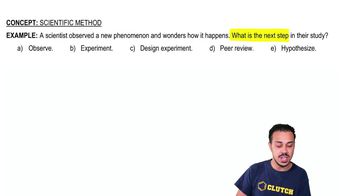
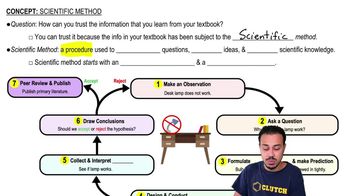
Make an observation, ask a question, form a testable hypothesis, make a prediction, conduct an experiment, analyze results, and report findings.
An experimental study manipulates variables to test hypotheses, while a correlation study observes relationships without manipulation.
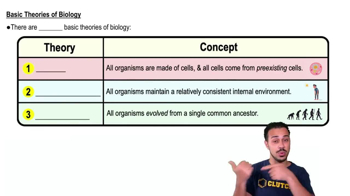
All living organisms are made of cells, which are the smallest units that perform all life activities.
Prokaryotic cells are simpler, smaller, and lack a nucleus and membrane-bound organelles.
Eukaryotic cells have a nucleus and membrane-enclosed organelles.
Gene expression is the process of converting information from DNA to RNA to protein.
Life requires energy input, mainly from the sun, which is transformed by producers into chemical energy passed to consumers.
New properties that arise from the arrangement and interaction of parts as biological complexity increases.
An approach that breaks complex systems into simpler components to study them more easily.
Evolution is the process by which living organisms are modified descendants of common ancestors, explaining unity and diversity of life.
Microevolution is small-scale genetic changes within populations over time, observable in organisms and fossils, and compatible with a Biblical worldview.
Theories explaining the origin of life from nonliving matter through chemical transformations.
RNA was the first self-propagating molecule capable of storing and transmitting genetic information and acting as a ribozyme, but not a cell.
A large prokaryote engulfed a smaller one, which became mitochondria or chloroplasts, explaining the origin of eukaryotic organelles.
It does not explain the origin of most organelles and requires many precise conditions to occur.