Skip to main content
General Biology
Il mio corso
Impara
Preparazione agli esami
AI Tutor
Guide di studio
Soluzioni per libri di testo
Flashcard
Esplora
Prova l'app
Il mio corso
Impara
Preparazione agli esami
AI Tutor
Guide di studio
Soluzioni per libri di testo
Flashcard
Esplora
Prova l'app
Indietro
General Biology: Nervous, Sensory, and Endocrine Systems
Puoi toccare per girare la carta.
Two types of cells in nervous tissue
Puoi toccare per girare la carta.
👆
Two types of cells in nervous tissue
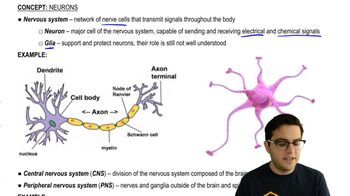
Neurons
transmit impulses;
neuroglia
support and protect neurons.
Avanzamenti del tracciato
I pulsanti di controllo sono stati cambiati in modalità "navigazione".
1/30
Video consigliati
12:47
Neurotransmitters
2898
views
22
rank
02:14
Nervous System
4996
views
78
rank
05:33
Postsynaptic Potentials and Summation
3675
views
17
rank
Termini in questo insieme (30)
Nascondere definizioni
Two types of cells in nervous tissue
Neurons
transmit impulses;
neuroglia
support and protect neurons.
Two major groups of nervous system organs
The
central nervous system (CNS)
and the
peripheral nervous system (PNS)
.
General functions of the nervous system
Sensory input, integration of data, and motor output.
General structure of a neuron
Consists of a
cell body
,
dendrites
(receive signals), and an
axon
(sends signals).
Classification of neurons by structure and function
Based on number of processes and direction of impulse: sensory, motor, and interneurons.
Functions of neuroglia in the CNS
Support neurons, form myelin, maintain environment, and protect the brain.
Schwann cells in the PNS
Form myelin sheath around peripheral axons to speed impulse conduction.
How a membrane becomes polarized
By maintaining a difference in ion concentration across the membrane, creating a resting membrane potential.
Events leading to an action potential
Depolarization to threshold, opening of Na+ channels, followed by repolarization as K+ channels open.
Impulse conduction in unmyelinated neurons
Continuous conduction where the impulse travels along every part of the membrane.
Impulse conduction in myelinated neurons
Saltatory conduction where impulses jump between nodes of Ranvier, increasing speed.
How information passes from one neuron to another
Via synapses using neurotransmitters that cross the synaptic cleft.
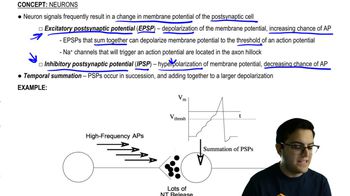
Membrane potential changes with excitatory neurotransmitters
Cause depolarization, making the neuron more likely to fire an action potential.
Membrane potential changes with inhibitory neurotransmitters
Cause hyperpolarization, making the neuron less likely to fire.
Classification of nerves
Based on direction: sensory, motor, or mixed nerves.
Parts of a reflex arc
Receptor, sensory neuron, integration center, motor neuron, and effector.
Coverings of the brain and spinal cord
The meninges: dura mater, arachnoid mater, and pia mater.
Major parts of the brain and their functions
Cerebrum (thought), cerebellum (coordination), brainstem (basic life functions).
Functions of cerebrospinal fluid
Cushions the brain, removes waste, and transports nutrients.
Functions of the autonomic nervous system
Controls involuntary body functions like heart rate and digestion.
Difference between sympathetic and parasympathetic divisions
Sympathetic prepares for 'fight or flight'; parasympathetic promotes 'rest and digest'.
Difference between general and special senses
General senses detect touch, pain, temperature; special senses include vision, hearing, taste, smell, and equilibrium.
Five kinds of sensory receptors
Mechanoreceptors, thermoreceptors, nociceptors, photoreceptors, and chemoreceptors.
Mechanism of smell
Odor molecules bind to receptors in the nasal cavity, triggering nerve impulses.
Mechanism of taste
Chemicals stimulate taste buds, sending signals to the brain.
Functions of parts of the ear
Outer ear collects sound; middle ear transmits vibrations; inner ear detects sound and balance.
Difference between static and dynamic equilibrium
Static equilibrium senses head position; dynamic equilibrium senses motion and acceleration.
Functions of parts of the eye
Cornea and lens focus light; retina detects light; optic nerve transmits signals.
Comparison of nervous and endocrine systems in homeostasis
Nervous system acts fast with electrical signals; endocrine system acts slower with hormones.
Difference between endocrine, autocrine, and paracrine secretions
Endocrine hormones act on distant cells; autocrine act on the same cell; paracrine act on nearby cells.
 IndietroIndietro
 12:47