 Indietro
General Biology: Nucleic Acids and RNA World
 01:05

Termini in questo insieme (20)
Phosphate group, five-carbon sugar, and nitrogenous base.
Ribonucleotides contain ribose sugar, while deoxyribonucleotides contain deoxyribose sugar (lacking one oxygen atom).
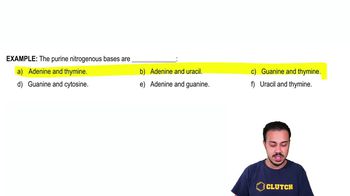
Purines: Adenine and Guanine (double-ring structures). Pyrimidines: Thymine, Cytosine, and Uracil (single-ring structures).
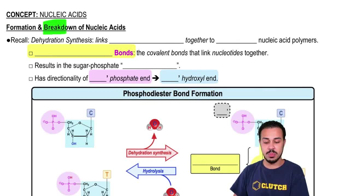
Via phosphodiester linkages formed by condensation reactions between the sugar's hydroxyl group and the phosphate group, releasing water.
Strands are read from the unlinked 5’ phosphate end to the unlinked 3’ hydroxyl end.
Phosphates are negatively charged; linking them creates covalent bonds with high potential energy due to repulsive forces, releasing energy when forming stable bonds.
Using X-ray crystallography, they found DNA has a helical and regular repeating structure.
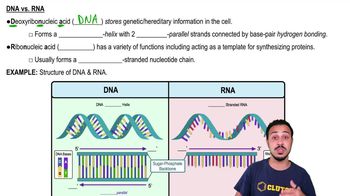
Two antiparallel strands twisted into a double helix, stabilized by hydrogen bonds between complementary base pairs and van der Waals interactions.
DNA undergoes supercoiling and forms chromatin to compact into discrete, movable units.
Serves as a template for DNA replication by allowing strands to separate and complementary strands to form.
RNA contains ribose, which has one more oxygen atom than DNA's deoxyribose.
Uracil replaces thymine in RNA.
RNA forms hydrogen bonds within the same strand, creating structures like hairpins, rather than between two strands.
Complex 3D shapes formed when secondary structures fold further, such as pseudoknots.
Transmits genetic information from DNA to synthesize polypeptides (proteins).
RNA molecules that can catalyze chemical reactions, similar to protein enzymes.
A complementary RNA strand forms using the original as a template, linking ribonucleotides via phosphodiester bonds.
Describes the flow of genetic information: DNA replicates, transcribes to RNA, which translates to protein.
Hydrogen bonds between complementary bases, hydrophobic interactions, and van der Waals forces stabilize the helix.
One strand runs 5’ to 3’, the other 3’ to 5’, allowing complementary base pairing and proper double helix formation.