 Indietro
General Biology: Nucleic Acids, Carbohydrates, Lipids, and Cell Structure
 01:05

Termini in questo insieme (20)
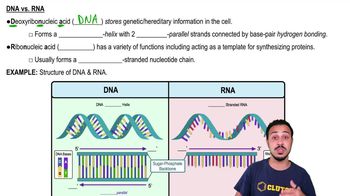
Nucleic acids are biomolecules (DNA and RNA) that store and transmit genetic information essential for cell function and heredity.
The RNA World hypothesis suggests that early life used RNA both to store genetic information and to catalyze chemical reactions before DNA and proteins evolved.
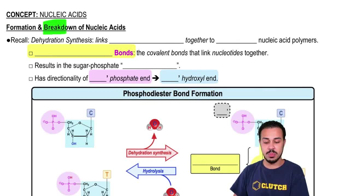
Nucleotides are the building blocks, each composed of a sugar, a phosphate group, and a nitrogenous base.
Adenine (A), Thymine (T), Cytosine (C), and Guanine (G) are the four bases in DNA.
Ribose is the sugar in RNA nucleotides, differing from DNA's deoxyribose by having one more oxygen atom.
Carbohydrates are organic molecules that provide energy, structural support, and serve as recognition molecules in cells.
Carbohydrates generally follow the formula \((CH_2O)_n\), where n is the number of carbon atoms.
Monosaccharides are single sugar units, disaccharides are two monosaccharides linked, and polysaccharides are long chains of monosaccharides.
Lipids store energy, form cell membranes, and act as signaling molecules.
Phospholipids, cholesterol, and glycolipids are key lipids in membranes.
A phospholipid has a hydrophilic phosphate head and two hydrophobic fatty acid tails, forming bilayers in membranes.
The lipid bilayer forms a semi-permeable membrane that controls substance entry and exit in cells.
Early cells likely had simple membranes made of lipids and contained RNA for genetic information and catalysis.
Cells contain a plasma membrane, cytoplasm, nucleic acids, proteins, and various organelles depending on cell type.
The cell membrane protects the cell, maintains homeostasis, and mediates communication and transport.
Carbohydrates on the cell surface act as recognition molecules for cell-cell communication and immune responses.
RNA has ribose sugar and uracil instead of thymine, and is usually single-stranded, unlike DNA.
Lipids are hydrophobic due to their long hydrocarbon chains, making them insoluble in water.
Polysaccharides like starch and glycogen store energy in plants and animals, respectively.
RNA can act as a ribozymes, catalyzing chemical reactions, supporting the RNA World hypothesis.