Triglycerides consist of one glycerol molecule and three fatty acids.
What are the three classes of carbohydrates?
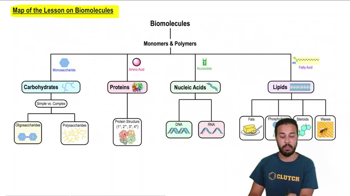
Carbohydrates include monosaccharides (simple sugars), disaccharides (double sugars), and polysaccharides (complex carbohydrates).
Give examples of common monosaccharides.
Common monosaccharides include glucose, fructose, and galactose.
How are monosaccharides classified?
By the location of the carbonyl group (aldose or ketose) and the number of carbons (e.g., trioses, pentoses, hexoses).
What is a glycosidic linkage?
A glycosidic linkage is the covalent bond formed by a dehydration reaction joining two monosaccharides into a disaccharide.
Name three important polysaccharides and their functions.
Starch (plant energy storage), glycogen (animal energy storage), and cellulose (plant cell wall structure).
What distinguishes saturated and unsaturated fats?
Saturated fats have single carbon-carbon bonds and are solid at room temperature; unsaturated fats have one or more double bonds and are liquid at room temperature.
Describe the structure of a phospholipid.
Phospholipids have a hydrophilic head (phosphate group + glycerol) and two hydrophobic fatty acid tails, making them amphipathic.
What is the role of phospholipids in cells?
Phospholipids form the bilayer of cell membranes, creating a barrier impermeable to water.
What is the basic structure of steroids?
Steroids have a backbone of four fused carbon rings and function as chemical messengers or membrane components.
List some examples of steroids.
Examples include cholesterol, testosterone, estrogen, progesterone, and vitamin D.
What are proteins made of?
Proteins are polymers made of amino acids linked in a unique linear sequence.
Name three functions of proteins.
Proteins function in enzymatic catalysis, transport (e.g., hemoglobin), and defense (e.g., antibodies).
What determines a protein's three-dimensional structure?
The sequence of amino acids determines the protein's 3D structure and function.
What are the four levels of protein structure?
Primary (amino acid sequence), secondary (coils and folds), tertiary (side chain interactions), and quaternary (multiple polypeptides).
What is protein denaturation?
Denaturation is the loss of a protein's native structure, causing it to become biologically inactive.
What are nucleic acids and their monomers?
Nucleic acids (DNA and RNA) are polymers of nucleotides, each containing a nitrogenous base, sugar, and phosphate group.
What nitrogenous bases are found in DNA?
DNA contains adenine (A), thymine (T), cytosine (C), and guanine (G).
How do nitrogenous bases pair in DNA?
Adenine pairs with thymine, and cytosine pairs with guanine via hydrogen bonds.
What are the differences between DNA and RNA?
DNA is double-stranded with deoxyribose sugar and thymine; RNA is single-stranded with ribose sugar and uracil instead of thymine.
 Indietro
 01:17