 Indietro
General Biology: Organic Molecules and Macromolecules
 01:17
01:17
Termini in questo insieme (36)
Carbon can form 4 covalent bonds, allowing it to connect with many atoms and form diverse molecules essential for life.
Organic compounds are carbon-containing compounds that make up living things.
Isomers are molecules with the same formula but different structures.
Functional groups are groups of atoms that give molecules specific properties and functions.
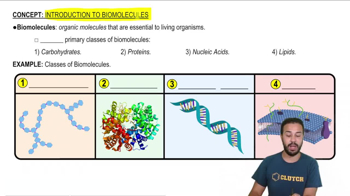
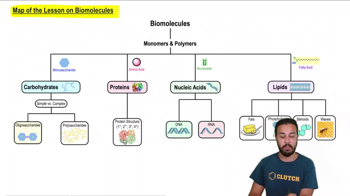
Carbohydrates, Proteins, Nucleic acids, and Lipids.
A monomer is a small building block; a polymer is a large molecule made by connecting many monomers.
Carbohydrates, Proteins, and Nucleic acids are polymers; Lipids are not true polymers.
Polymers are built by enzymes through dehydration reactions, which remove water to join monomers.
Polymers are broken down by hydrolysis, which adds water to break bonds between monomers.
Dehydration removes water to build molecules; hydrolysis adds water to break molecules apart.
Carbohydrates contain carbon, hydrogen, and oxygen.
Monosaccharides are simple sugars and the building blocks of carbohydrates.
Glucose is C₆H₁₂O₆, a common monosaccharide used for energy.
By the number of carbons (e.g., pentose, hexose) and the location of the carbonyl group (aldose or ketose).
Glycosidic linkages are covalent bonds joining sugar monomers in carbohydrates, formed by dehydration.
Energy storage and structural support.
Both made of glucose; starch has alpha (α) linkages and stores energy, cellulose has beta (β) linkages and provides structure.
Humans lack enzymes to break beta (β) glycosidic linkages in cellulose, so it passes as insoluble fiber.
Chitin is a glucose-based polysaccharide used for structural support in insect exoskeletons and fungal cell walls.
Lipids are non-polymeric, hydrophobic molecules made mostly of hydrocarbon chains.
Fats, phospholipids, and steroids.
Fats are made of glycerol linked to three fatty acids via ester linkages.
Saturated fatty acids have no double bonds and pack tightly (solid at room temp); unsaturated have one or more double bonds causing kinks (liquid at room temp).
Phospholipids form the cell membrane bilayer with hydrophilic heads facing water and hydrophobic tails inside.
Steroids have a carbon skeleton of four fused rings, e.g., cholesterol, which stabilizes membranes and serves as hormone precursors.
Proteins are polymers of amino acids linked by peptide bonds.
A protein's 3D shape, which depends on its amino acid sequence and folding.
Primary (amino acid sequence), Secondary (α helices and β sheets), Tertiary (3D folding), Quaternary (multiple polypeptide subunits).
Hydrogen bonds, ionic bonds, hydrophobic interactions, van der Waals forces, and disulfide bridges.
Loss of a protein's native shape due to environmental changes (pH, temperature), often causing loss of function.
Nucleic acids (DNA and RNA) are polymers of nucleotides, each made of a nitrogenous base, pentose sugar, and phosphate group.
DNA contains deoxyribose sugar and thymine; RNA contains ribose sugar and uracil instead of thymine.
Phosphodiester bonds link sugars and phosphate groups in the sugar-phosphate backbone.
Complementary base pairing via hydrogen bonds: adenine with thymine, guanine with cytosine.
Two DNA strands run in opposite directions: one 5'→3', the other 3'→5'.
DNA is transcribed into RNA, which is translated into protein.