 Indietro
General Biology: Photosynthesis and Membrane Transport Study Guide
 03:32

Termini in questo insieme (31)
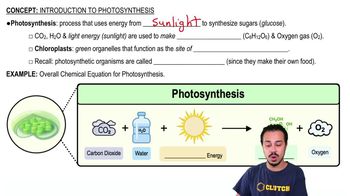
Autotrophs produce organic molecules from inorganic materials using an energy source (e.g., sunlight for photoautotrophs). Heterotrophs obtain organic molecules by consuming other organisms or their products.
Chloroplasts are in leaf mesophyll cells. Key structures include the stroma, thylakoids, thylakoid space, and grana (stacks of thylakoids).
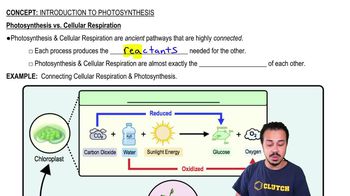
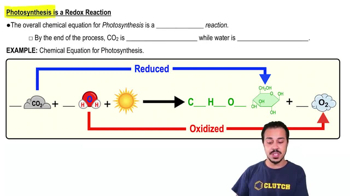
6 CO₂ + 6 H₂O + light energy → C₆H₁₂O₆ + 6 O₂. Reactants are carbon dioxide, water, and light; products are glucose and oxygen.
Light reactions occur in the thylakoid membranes, and the Calvin cycle occurs in the stroma of chloroplasts.
Convert light energy into ATP and NADPH, and release O₂ from splitting water.
Use ATP and NADPH to fix CO₂ and build sugar precursors like G3P.
Light behaves as waves and photons. Chlorophyll a is the primary pigment; chlorophyll b and carotenoids are accessory pigments that broaden absorption and protect against excess light.
A photosystem includes a light-harvesting complex and a reaction-center complex. PSII acts first, splitting water and starting electron flow; PSI helps reduce NADP⁺ to NADPH.
Electron transport pumps H⁺ into the thylakoid space, creating a gradient. ATP synthase uses H⁺ flow back into the stroma to produce ATP by chemiosmosis.
Both use a proton gradient and ATP synthase. In chloroplasts, H⁺ accumulates in the thylakoid space and flows into the stroma. In mitochondria, H⁺ accumulates in the intermembrane space and flows into the matrix.
(1) Carbon fixation: CO₂ attaches to RuBP. (2) Reduction: ATP and NADPH produce G3P. (3) Regeneration: RuBP is rebuilt to continue the cycle.
Photorespiration occurs when rubisco binds O₂ instead of CO₂, wasting energy and resources without producing sugar. It is more common in hot, dry conditions.
C3: Fix CO₂ directly; vulnerable to photorespiration. C4: Separate initial CO₂ fixation and Calvin cycle in different cells to concentrate CO₂. CAM: Fix CO₂ at night, Calvin cycle during day; stomata close in hot daytime.
It supplies organic molecules for food webs and releases oxygen used in aerobic respiration, linking to the global carbon cycle.
The membrane is a flexible phospholipid bilayer with embedded proteins that move laterally, creating a mosaic of components.
They have hydrophilic (water-attracting) heads and hydrophobic (water-repelling) tails, allowing bilayer formation.
Transport, enzymatic activity, signal transduction, cell-cell recognition, intercellular joining, and attachment to cytoskeleton/ECM.
Cholesterol content, temperature, and the saturation level of fatty acid tails (unsaturated tails increase fluidity).
The membrane allows some substances to cross more easily than others, favoring nonpolar molecules over many polar molecules and ions.
Channel proteins form pores for molecules to pass; carrier proteins change shape to transport specific substances.
Diffusion: movement of molecules down a concentration gradient. Osmosis: diffusion of water across a selectively permeable membrane.
In hypotonic: animal cells may lyse, plant cells become turgid. Isotonic: cells remain normal. Hypertonic: animal cells shrivel, plant cells plasmolyze.
Facilitated diffusion is passive, moving substances down their gradient via proteins. Active transport requires energy to move substances against their gradient.
It uses ATP to move Na⁺ out and K⁺ into the cell against their concentration gradients, maintaining membrane potential.
Membrane potential is the voltage across a membrane. Electrochemical gradient combines chemical concentration and electrical charge differences driving ion movement.
Movement of one substance down its gradient drives the uphill transport of another substance across the membrane.
Exocytosis releases materials by vesicle fusion with the membrane; endocytosis takes in materials by vesicle formation.
Phagocytosis (cell eating), pinocytosis (cell drinking), and receptor-mediated endocytosis (selective uptake via receptors).
Reception (signal detection), transduction (signal relay and amplification), and response (cellular activity change).
GPCRs and ligand-gated ion channels are cell-surface receptors; intracellular receptors bind signals that cross the membrane, like steroid hormones.
Protein kinases add phosphate groups to proteins; phosphatases remove them. cAMP acts as a second messenger to amplify signals.