 Indietro
General Biology: Photosynthesis and Metabolism
 03:32

Termini in questo insieme (27)
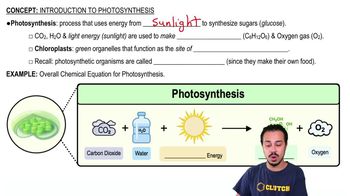
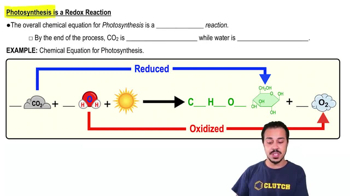
6 CO2 + 6 H2O + light energy → C6H12O6 + 6 O2. Water is oxidized, CO2 is reduced, and oxygen comes from water.
Photosynthesis is an endergonic reaction because it requires energy input from sunlight to produce glucose.
Stomata regulate gas exchange by allowing CO2 to enter and O2 to exit the leaf, essential for photosynthesis.
Water is absorbed by roots via osmosis and moves upward driven by transpiration, cohesion, and adhesion.
Chloroplasts have thylakoid membranes with pigments (chlorophyll) for light absorption and stroma where the Calvin cycle occurs.
Light reactions occur in thylakoids, carbon fixation via Rubisco in carboxysomes, and the Calvin cycle in the cytoplasm.
Chlorophyll absorbs mainly blue and red light; blue light has more energy than red.
Plants look green because chlorophyll reflects green wavelengths and absorbs blue and red light.
Being nonpolar helps chlorophyll embed in the hydrophobic thylakoid membranes for efficient light absorption.
Substrates: light, water, ADP, NADP+. Products: ATP, NADPH, and O2.
Electrons come from water, are excited twice by light in photosystems II and I, and finally reduce NADP+ to NADPH.
ATP is made by ATP synthase using a proton gradient; NADPH is made by reducing NADP+ with electrons from photosystem I.
Passive: protons move down gradient through ATP synthase. Active: electron transport pumps protons into thylakoid lumen.
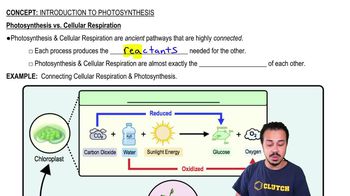
Both use electron transport chains to create a proton gradient that drives ATP synthesis via ATP synthase.
Substrates: CO2, ATP, NADPH. Products: G3P (glyceraldehyde 3-phosphate), ADP, NADP+.
Occurs in the stroma of chloroplasts and in the cytoplasm of bacteria.
Calvin cycle uses ATP and NADPH to reduce CO2 to sugar; Citric Acid cycle oxidizes organic molecules to produce ATP and electron carriers.
Energy is transferred or transformed but not created or destroyed in metabolic reactions.
Entropy increases in closed systems, but organisms are open systems that exchange energy to maintain order.
Because of the arrangement of atoms and their free energy state in covalent bonds.
Exergonic reactions release energy (ΔG < 0); endergonic reactions require energy input (ΔG > 0).
To drive non-spontaneous reactions by pairing them with spontaneous ones, often via ATP hydrolysis.
ATP transfers energy by hydrolyzing its high-energy phosphate bonds, releasing a phosphate group.
Cellular respiration regenerates ATP from ADP and phosphate using energy from food molecules.
By stabilizing the transition state, orienting substrates, providing a favorable microenvironment, and stressing substrate bonds.
Competitive inhibitors bind the active site; noncompetitive inhibitors bind elsewhere altering enzyme shape.
Gene regulation, enzyme activation/deactivation, feedback inhibition, and localization/compartmentalization.