What are the five key derived traits of plants absent in green algae?
Heteromorphic alternation of generations, multicellular dependent embryos, walled spores produced in sporangia, multicellular gametangia, and apical meristems.
Define alternation of generations in plants.
Plants alternate between a haploid gametophyte generation producing gametes by mitosis and a diploid sporophyte generation producing spores by meiosis.
What is the ploidy and role of the sporophyte?
The sporophyte is diploid (2n) and produces haploid spores by meiosis.
What is the ploidy and role of the gametophyte?
The gametophyte is haploid (n) and produces haploid gametes by mitosis.
How do plant embryos depend on the parent?
Plant embryos are retained within female gametophyte tissue and receive nutrients via placental transfer cells, making plants embryophytes.
What is the function of sporangia in plants?
Sporangia are organs where diploid sporocytes undergo meiosis to produce haploid spores with resistant walls containing sporopollenin.
What are gametangia and their types?
Gametangia are multicellular organs producing gametes: archegonia produce eggs, and antheridia produce and release sperm.
What is the role of apical meristems?
Apical meristems sustain continual growth by repeated cell division, producing cells that differentiate into various tissues.
What are bryophytes and their major characteristics?
Bryophytes are nonvascular plants (liverworts, mosses, hornworts) with dominant gametophytes, small size, and dependence on water for sperm motility.
How do bryophyte sporophytes differ from gametophytes?
Bryophyte sporophytes are smaller, simpler, and dependent on the gametophyte, which is the dominant, longer-living generation.
What adaptations allowed seedless vascular plants to grow tall?
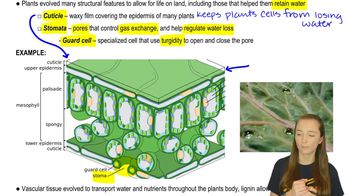
Vascular tissue (xylem and phloem) enabled transport of water and nutrients and provided structural support for increased height.
What are the two types of vascular tissue and their functions?
Xylem conducts water and minerals and provides support; phloem distributes sugars and organic nutrients.
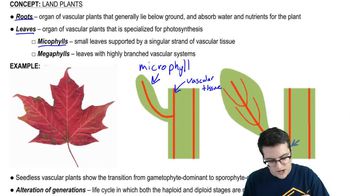
What are microphylls and megaphylls?
Microphylls are small leaves with a single vein; megaphylls are larger leaves with a branched vascular system.
What are sporophylls?
Sporophylls are modified leaves that bear sporangia; clusters of sporangia are called sori, and groups of sporophylls can form strobili.
Define homospory and heterospory.
Homospory produces one spore type developing into bisexual gametophytes; heterospory produces microspores and megaspores developing into male and female gametophytes.
What are the four common traits of seed plants?
Seed plants have reduced gametophytes, heterospory, ovules, and pollen.
Why are gametophytes reduced in seed plants?
They are microscopic and develop within spores retained in sporophyte tissues, protecting them and allowing nutrient transfer.
What is an ovule in seed plants?
An ovule consists of a megasporangium, megaspore, and protective integuments; gymnosperms have one integument, angiosperms usually two.
What is pollen and its evolutionary advantage?
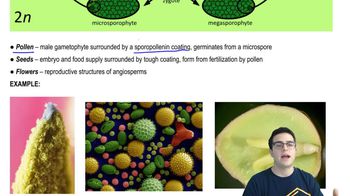
Pollen grains contain male gametophytes; pollen allows sperm delivery without water and can be dispersed by wind or animals.
What evolutionary advantages do seeds provide?
Seeds protect embryos, provide stored food, can remain dormant until conditions are favorable, and enable long-distance dispersal.
What are the key features of the gymnosperm life cycle?
Miniaturized gametophytes, seed production, and sperm transfer to ovules by pollen.
What are the key features of the angiosperm life cycle?
Miniaturized gametophytes, flowers to attract pollinators, seed production, pollen transfer via pollinators, double fertilization, and fruit formation.
What is double fertilization in angiosperms?
One sperm fertilizes the egg forming a diploid zygote; another sperm fertilizes two polar nuclei forming triploid endosperm.
What is the role of fruits in angiosperms?
Fruits develop from the ovary wall, protect seeds, and aid in seed dispersal by various mechanisms.
How do animals influence plant evolution?
Animal herbivory selects for plant defenses; pollinators and plants coevolve mutually beneficial adaptations.
 Indietro
 06:17