Indietro

General Biology: Plant Structure and Growth

I pulsanti di controllo sono stati cambiati in modalità "navigazione".
1/26
  • What are the two main groups of angiosperms?

    Monocots and eudicots.
  • How many cotyledons do monocots and eudicots have?

    Monocots have one cotyledon, eudicots have two cotyledons.
  • List key differences between monocots and eudicots.

    Monocots: parallel veins, scattered vascular tissue, fibrous roots, pollen with 1 opening, floral organs in multiples of 3. Eudicots: netlike veins, vascular tissue in a ring, taproot, pollen with 3 openings, floral organs in multiples of 4 or 5.
  • Name some examples of monocots.

    Orchids, lilies, grasses, palms.
  • Name some examples of eudicots.

    Oaks, maples, roses, peas.
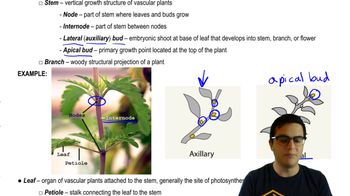
  • What are nodes and internodes on a stem?

    Nodes are points where leaves and branches grow; internodes are the stem segments between nodes.
  • What is an axillary bud and an apical bud?

    An axillary bud is located in the leaf axil; an apical bud is at the stem tip and is the primary growth point.
  • What is apical dominance?

    The phenomenon where the apical bud suppresses growth of axillary buds.
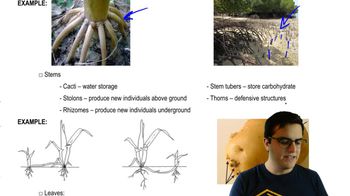
  • What are adventitious roots?

    Roots that develop from non-root tissues such as stems or leaves.
  • What are root hairs and their function?

    Tiny extensions of root epidermal cells that increase surface area for water and nutrient absorption.
  • Name the five major plant cell types.

    Parenchyma, collenchyma, sclerenchyma, water-conducting cells, food-conducting cells.
  • What is the function of parenchyma cells?

    Food storage and photosynthesis; most abundant plant cell type.
  • What is the role of collenchyma cells?

    Provide flexible support to growing parts of the plant.
  • What characterizes sclerenchyma cells?

    Rigid walls with lignin; provide structural support and make wood hard.
  • What are the two types of water-conducting cells?

    Xylem cells that transport water from roots to leaves and contain lignin.
  • What is the function of food-conducting cells?

    Phloem cells that transport sugars from leaves to roots.
  • What are the three major plant tissue systems?

    Epidermis (outer protective layer), vascular tissue (xylem and phloem), and ground tissue (mostly parenchyma).
  • What is the function of the epidermis in plants?

    Protects the plant and conserves water.
  • What is the difference between xylem and phloem?

    Xylem transports water from roots to leaves; phloem transports sugars from leaves to roots.
  • What is indeterminate growth in plants?

    Growth that continues throughout the plant's life, allowing continuous lengthening and widening.
  • What is a meristem?

    Localized regions of unspecialized cells that divide to produce new cells for growth.
  • What is the difference between primary and secondary growth?

    Primary growth increases length via apical meristems; secondary growth increases width via vascular and cork cambium.
  • Where does primary growth occur in plants?

    At apical meristems located in root tips and terminal and axillary buds.
  • What tissues are responsible for secondary growth?

    Vascular cambium and cork cambium.
  • What is heartwood and sapwood in a tree?

    Heartwood is non-functioning older xylem in the center; sapwood is younger xylem that conducts water.
  • What makes up the bark of a tree?

    Secondary phloem, cork cambium, and cork.