 Indietro
General Biology: Population Genetics and Evolution
 03:31

Termini in questo insieme (21)
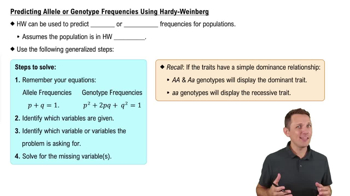
The Hardy-Weinberg equilibrium states that allele and genotype frequencies in a large population remain constant from generation to generation in the absence of evolutionary forces.
Frequency of allele 1 is p, frequency of allele 2 is q, and p + q = 1.
The genotype frequencies are predicted by \(p^2 + 2pq + q^2 = 1\), where p² = homozygous dominant, 2pq = heterozygous, and q² = homozygous recessive.
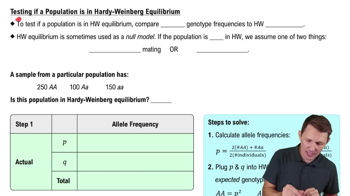
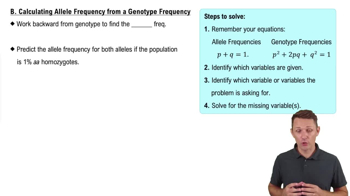
Allele frequency = (2 × number of homozygotes + number of heterozygotes) / (2 × total individuals).
No natural selection, no genetic drift (large population), no gene flow, no mutation, and random mating.
Natural selection, genetic drift (small population), gene flow, mutation, and non-random mating.
Fitness is the relative ability of a genotype to survive and reproduce, contributing offspring to the next generation.
An adaptation is a heritable trait that increases an individual's fitness compared to others without the trait.
Natural selection increases the frequency of alleles that confer higher fitness and decreases those with lower fitness.
Genetic drift is random change in allele frequencies, especially in small populations, which can reduce genetic variation.
Gene flow is the movement of alleles between populations, which can introduce new alleles and increase genetic variation.
Mutations introduce new alleles into a population, providing raw material for evolution.
Evolution is defined as a change in allele frequencies in a population's gene pool over time.
Evolution has occurred if allele or genotype frequencies differ from those predicted by Hardy-Weinberg equilibrium.
The gene pool is the total collection of alleles for all genes in a population.
Mutations in the rpoB gene alter RNA polymerase, causing resistance to rifampin antibiotic.
Antibiotics kill susceptible bacteria, allowing resistant mutants to survive and reproduce, increasing resistance allele frequency.
Variation exists, traits are heritable, survival/reproduction vary, and individuals with advantageous traits reproduce more.
Non-random mating changes genotype frequencies and can increase homozygosity, affecting evolutionary dynamics.
Directional, stabilizing, and disruptive selection, each affecting trait distribution differently.
Directional selection favors one extreme phenotype, shifting the population's trait mean in that direction.