Skip to main content
General Biology
Il mio corso
Impara
Preparazione agli esami
AI Tutor
Guide di studio
Soluzioni per libri di testo
Flashcard
Esplora
Prova l'app
Il mio corso
Impara
Preparazione agli esami
AI Tutor
Guide di studio
Soluzioni per libri di testo
Flashcard
Esplora
Prova l'app
Indietro
General Biology: Principles of Evolution
Puoi toccare per girare la carta.
What is the unifying principle of modern biology?
Puoi toccare per girare la carta.
👆
What is the unifying principle of modern biology?
Evolutionary theory explains the diversity of life and ancestral traits through
descent with modification
.
Avanzamenti del tracciato
I pulsanti di controllo sono stati cambiati in modalità "navigazione".
1/23
Video consigliati
07:48
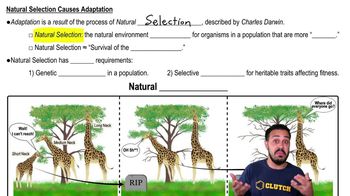
Natural Selection Causes Adaptation
15763
views
381
rank
3
comments
02:57
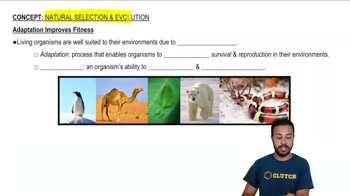
Adaptation Improves Fitness
19210
views
482
rank
1
comments
04:32
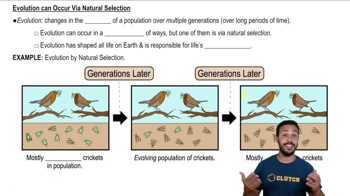
Evolution can Occur Via Natural Selection
13468
views
320
rank
2
comments
Termini in questo insieme (23)
Nascondere definizioni
What is the unifying principle of modern biology?
Evolutionary theory explains the diversity of life and ancestral traits through
descent with modification
.
What do vestigial structures demonstrate?
They show that ancestral traits persist even after losing primary utility, indicating evolutionary history.
Who proposed the idea of ideal forms and a linear hierarchy of organisms?
Plato
proposed ideal forms;
Aristotle
arranged organisms in a linear hierarchy called the
Great Chain of Being
.
What discovery provided physical evidence that life changed over time?
The discovery of
fossils
, preserved remains of organisms, showed life’s progression.
What is Catastrophism?
Theory that successive natural disasters caused species extinctions and fossil layers, proposed to explain fossil record without evolution.
What principle suggests Earth is shaped by slow, ongoing processes over vast time?
Uniformitarianism
, developed by geologists like James Hutton, states Earth’s features result from gradual processes.
What was Lamarck's theory of evolution?
Inheritance of acquired characteristics: traits changed by use or disuse are passed to offspring (later refuted).
Who developed the theory of evolution by natural selection?
Charles Darwin
developed the theory;
Alfred Russel Wallace
independently conceived and supported it.
What is the focus shift in biology introduced by Darwin and Wallace?
From individuals to populations, recognizing populations evolve over time through natural selection.
State Darwin and Wallace’s first postulate of natural selection.
Individuals in a population vary due to random mutations.
State Darwin and Wallace’s second postulate of natural selection.
Traits are heritable and passed from parent to offspring.
State Darwin and Wallace’s third postulate of natural selection.
More individuals are born than can survive and reproduce.
State Darwin and Wallace’s fourth postulate of natural selection.
Survival and reproduction depend on specific heritable traits, not chance.
Why is blended inheritance incompatible with natural selection?
Blended inheritance would eliminate extreme traits and variation, halting evolution by removing natural selection’s raw material.
How does Mendelian genetics support evolution?
Alleles remain discrete, allowing extreme phenotypes to reappear and maintain variation for natural selection.
What are homologous structures?
Anatomical features with different functions but shared evolutionary origin, e.g., human arm and chicken wing bones.
What are vestigial structures?
Inherited structures with no current function, like wisdom teeth or flightless ostrich wings, indicating evolutionary history.
What are analogous structures?
Structures similar in function but different in origin, resulting from convergent evolution, e.g., insect and bird wings.
What does embryology reveal about evolution?
Early vertebrate embryos share features like tails and gill slits, indicating common ancestry.
How does molecular biology support evolution?
All organisms use DNA, RNA, ribosomes, 20 amino acids, and ATP, showing relatedness and allowing molecular clocks.
What evolutionary change occurred in the Silent Crickets of Kauai?
A mutation silenced male cricket calls, avoiding parasitic flies and increasing survival and reproduction.
How does herbicide resistance illustrate natural selection?
Random mutations confer resistance; herbicide kills susceptible individuals, leaving resistant ones to reproduce.
What is artificial selection?
Human-directed breeding selecting for desired traits, demonstrating how selection changes populations.
 IndietroIndietro
 07:48